A New Map of the “Dark Proteome”
Public proteomics and immunopeptidomics data reveals hundreds of tiny protein-like molecules that fall outside current annotations
A large-scale reanalysis of public proteomics data has brought more than 1,700 previously overlooked microproteins into view, expanding what researchers can detect in the human “dark proteome.” Led by the TransCODE Consortium, the study analyzed thousands of understudied genomic regions that fall outside conventional protein-coding annotations.
The team searched 7,264 non-canonical open reading frames against 95,520 public proteomics experiments, covering 3.7 billion mass spectra from protease-digested samples and human leukocyte antigen (HLA) immunopeptidomics datasets. Using the PeptideAtlas framework, the researchers found peptide evidence for 1,785 microproteins, with HLA-presented peptides providing much of the support. A smaller subset showed conventional mass spectrometry evidence strong enough to support potential protein-coding annotation.
The microproteins also differed sharply from canonical proteins in size, with 65 percent containing fewer than 50 amino acids. Because most do not yet have the functional evidence normally expected for protein annotation, the consortium proposes a new category, “peptideins,” for experimentally detected protein-like molecules whose biological roles remain uncertain.
“We know that the current overview of recognized proteins doesn’t capture the full picture,” said Sebastiaan van Heesch, who co-led the study, in a press release. “By classifying these molecules of unknown functionality as peptideins, we’ve given them a formal place in reference databases so the wider community can study them.”
Functional genomic analyses highlighted six candidate peptideins with pan-essential signatures, including one produced from the OLMALINC long non-coding RNA. Loss of this peptidein impaired survival in more than 85 percent of tested cancer cell lines, linking it to cell division and DNA damage response.
The researchers say the open-source resources could support future studies of cancer antigens, genetic disease, and new therapeutic targets. “We hope to inspire a new wave of research into peptideins and to unlock new insights and drug targets across human biology, particularly for the development of cellular immunotherapies and cancer vaccines,” said van Heesch.
The Soil Signature of an Old Forest
FT-ICR MS shows that preserved old-growth plots contained more carbohydrates, lipids, and protein-like soil compounds than degraded forest
Preserved old-growth stands of Ocotea porosa in Brazil’s Atlantic Forest show richer soil chemistry and biological activity than nearby degraded forests, according to a three-year field study. Comparing preserved and degraded plots in subtropical Cambisols, researchers found that conservation status shaped soil structure, microbial activity, fungal symbiosis, and the molecular composition of dissolved soil organic matter.
To probe that molecular composition, the team used Fourier-transform ion cyclotron resonance mass spectrometry (FT-ICR MS) on dissolved organic matter extracted from bulk soil. The analysis grouped detected molecules by elemental formula and chemical class, showing that preserved plots contained higher contributions from carbohydrates, lipids, and proteins/amino sugars, while degraded plots were enriched in condensed aromatic and polyphenolic compounds.
Those molecular differences tracked broader changes in soil function. Preserved plots showed higher soil organic matter, exchangeable cations, available phosphorus and sulfur, microbial carbon biomass, respiration, total glomalin, and organic acids such as oxalic and malic acid. Soil aggregation also improved, while bulk density was lower than in degraded plots.
The biological signal extended to arbuscular mycorrhizal fungi. Preserved plots showed higher root colonization and were associated with Acaulosporaceae and Gigasporaceae, while degraded plots were linked to Claroideoglomus claroideum, Funneliformis mosseae, and Rhizophagus intraradices. Structural equation modeling suggested that soil function reflected the combined influence of fungal community structure, dissolved organic matter chemistry, and physical–biochemical soil properties.
The authors argue that protecting old-growth O. porosa forests could help maintain soil function, support carbon sequestration, and conserve an endangered Atlantic Forest tree species.
Lipid-Trap MS Maps Lipid Binding in Mammalian Cells
The detergent-free workflow preserves lipid–protein associations and reveals cell cycle-dependent lipid binding during cytokinesis
A new technique called lipid-trap mass spectrometry (LTMS) allows researchers to capture lipid–protein interactions directly from mammalian cells, offering a way to study how membrane-associated proteins engage with specific lipid species closer to their native cellular context. Developed by researchers at King’s College London, the workflow combines tagged-protein pulldown with lipidomic mass spectrometry to identify lipids bound to, or locally associated with, proteins of interest.
The method uses detergent-free cell lysis to help preserve protein–lipid associations, followed by immunoprecipitation of green fluorescent protein (GFP)-tagged proteins on antibody-coated magnetic beads. Bound lipids are then extracted and analyzed by ultra-high-performance liquid chromatography–mass spectrometry. Control pulldowns remove background signals from the tag or beads, while tandem mass spectrometry and lipid databases support assignment of enriched lipid features.
After validating the approach with known lipid–protein interactions, the team applied lipid-trap mass spectrometry to cytokinesis, the final stage of cell division. Two cell-division proteins, RACGAP1 and charged multivesicular body protein 4B (CHMP4B), showed cell cycle-dependent lipid binding, including interactions with specific phosphoinositide species in dividing cells.
The workflow also captured unexpected associations with phospholipids, sphingolipids, and triacylglycerols. CHMP4B and charged multivesicular body protein 2A (CHMP2A), both involved in membrane abscission, showed distinct lipid profiles: CHMP4B associated with a broader range of charged and neutral lipids, while CHMP2A was linked mainly to neutral lipid species.
The authors suggest the method could be extended to other membrane-associated proteins, creating a route to more systematic studies of lipid–protein interactions in cell biology.
Pitcher Plants May Transfer Nutrients to Wasps
Nitrogen-15 enrichment in fen wasps points to a more fluid ecological relationship between Darlingtonia and its insect visitors
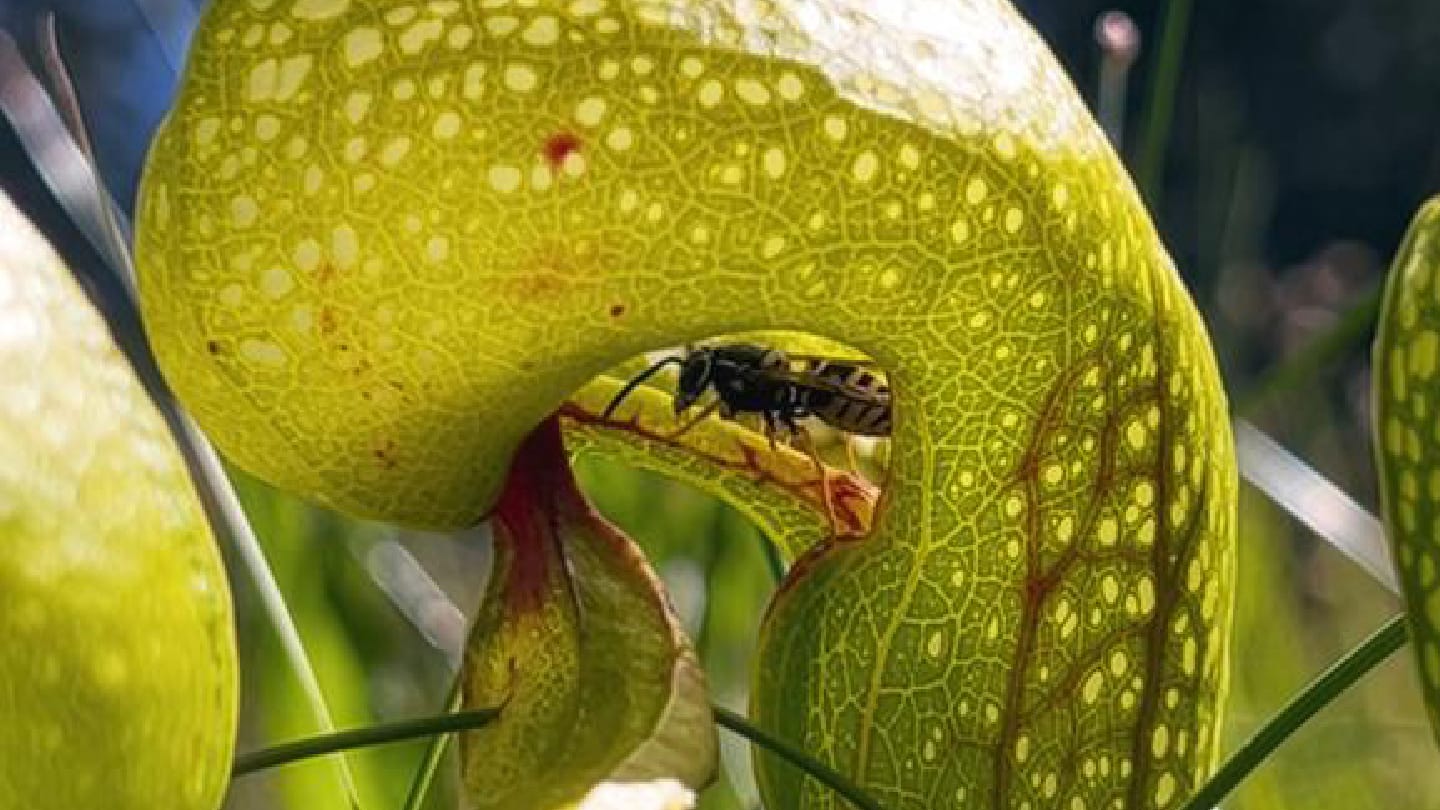
Carnivorous pitcher plants may not have a purely predatory relationship with their insect visitors, according to a stable isotope study of Darlingtonia californica and nearby vespid wasps. Researchers at the Okinawa Institute of Science and Technology found that wasps collected in pitcher plant fens carried a measurable nitrogen isotope signal consistent with nutrient transfer from the plants they sometimes visit, feed from, and occasionally fall prey to.
To test for nutrient transfer, the team compared nitrogen-15 enrichment in wasps collected from dense Darlingtonia stands with wasps from nearby forest sites lacking carnivorous plants. Isotope ratio mass spectrometry was used to measure nitrogen isotope signatures in dried wasp and plant samples.
As expected, Darlingtonia tissue was strongly enriched in nitrogen-15 compared with surrounding non-carnivorous plants, consistent with its insect-derived nitrogen supply. Wasps from pitcher fens also showed a smaller but significant enrichment relative to forest wasps. Bootstrapped analysis put the mean difference at 0.41 parts per thousand, and a Bayesian mixed-effects model supported the same directional pattern, though enrichment was evident at only three of the five study sites.
“Generally, we ecologists like to categorize relationships as just being one fixed, discrete type of interaction, such as predator-prey or competitive,” said senior author David Armitage in a press release. “But what we're becoming more aware of is that these ecological interactions are much more context-dependent and fluid.”
The isotope data do not prove that the relationship is mutualistic, because the route of nitrogen transfer remains unresolved. Wasps may acquire pitcher-derived nitrogen directly from nectar or indirectly by feeding on arthropods supported by the plants. Even so, the findings suggest that Darlingtonia may help structure local food webs rather than simply depleting insect populations.
(Mass) Spectacular and Strange
The Electrochemistry of a Better Brew
Coffee may be judged by taste, aroma, and the occasional fiercely held personal preference, but researchers at the University of Oregon have shown that its flavor profile can also be probed electrochemically.
The team repurposed a potentiostat, more often used to test batteries and fuel cells, to analyze brewed coffee without additional sample preparation. Using cyclic voltammetry, they tracked electrochemical features linked to proton-driven reactions at a platinum electrode. Those features changed with beverage strength, but were also suppressed as coffee compounds accumulated on the electrode surface, allowing the method to separate strength from roast color.
High-performance liquid chromatography coupled with high-resolution mass spectrometry was then used to analyze material recovered from the electrode, confirming caffeine among the adsorbed compounds. In a single-blind roastery test, the electrochemical method identified a rejected batch that refractive index measurements could not distinguish from accepted samples.
The result is not a replacement for the palate, but a possible electrochemical shortcut for tracking the chemistry behind a consistent cup. “For the coffee nerds at home, this is the first step towards understanding why you enjoy coffee, at a molecular level of precision,” said corresponding author Christopher Hendon.
Newsletters
Receive the latest analytical science news, personalities, education, and career development – weekly to your inbox.