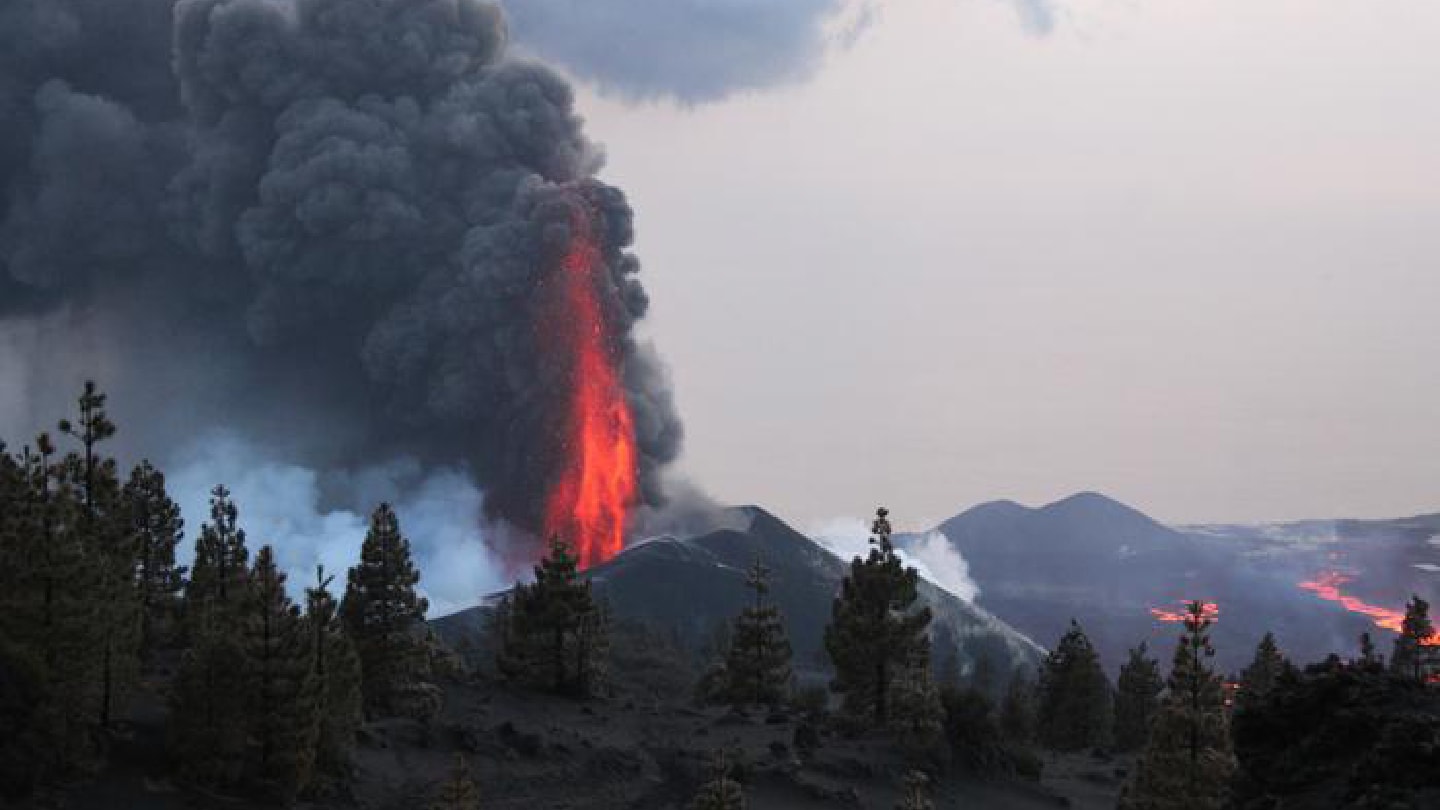
A study of magma from the 2021 Tajogaite eruption has identified superheating as a key control on crystal formation during ascent, offering a new explanation for why otherwise similar mafic magmas can erupt as either lava fountains or more effusive flows.
The study tackles a long-running question in volcanology: whether crystallization simply resumes once magma cools back below the liquidus, or whether prior heating leaves a kinetic legacy. Using Tajogaite tephrite as a natural case study, the Manchester-led team found that strong superheating dissolves pre-existing crystal nuclei and homogenizes the melt, making it harder for new crystals to form during ascent.
To track that process, the researchers combined a newly developed X-ray transparent pressure vessel with synchrotron X-ray microtomography at Diamond Light Source, allowing crystallization to be observed in situ in real time. Longer ex situ experiments in Prague extended the observation window, while Raman spectroscopy and differential scanning calorimetry helped test whether superheating had erased nanolite-scale nuclei and shifted crystallization onset.
“The history of crystal and bubble growth can dramatically control how a magma erupts,” said lead author Barbara Bonechi in a recent press release. “Until now, we did not fully understand the dynamics of crystal growth for magmas that received an injection of superheat just before ascent. But using our exciting and newly developed X-ray transparent pressure vessel combined with synchrotron X-ray microtomography we can actually observe these processes ‘in situ’.”
Supporting analyses helped explain why that delay occurs in the first place. Raman spectroscopy found no detectable nanolites in the starting materials, while calorimetry showed that stronger superheating pushed crystallization onset to lower temperatures, meaning greater undercooling was needed before crystal growth resumed.
What changed most was the timing of crystallisation. Magma that had not been superheated began forming crystals within around 20 minutes, whereas strongly superheated magma delayed crystal formation for more than eight hours. In the numerical models, that delay helped keep magma less crystalline and less viscous during ascent, promoting rapid rise and lava fountaining. Earlier crystallization, by contrast, slowed ascent, increased viscosity, and gave volcanic gases more time to escape.
Co-author Margherita Polacci said the implications reach beyond magma chemistry alone. “Current volcanic hazard models typically focus on magma chemistry, gas content and pressure changes,” she said. “This work suggests that pre-eruptive thermal history and crystallization kinetics may also play an important role in controlling magma ascent and eruptive behavior, with implications for volcanic hazard assessment.”
Newsletters
Receive the latest analytical science news, personalities, education, and career development – weekly to your inbox.