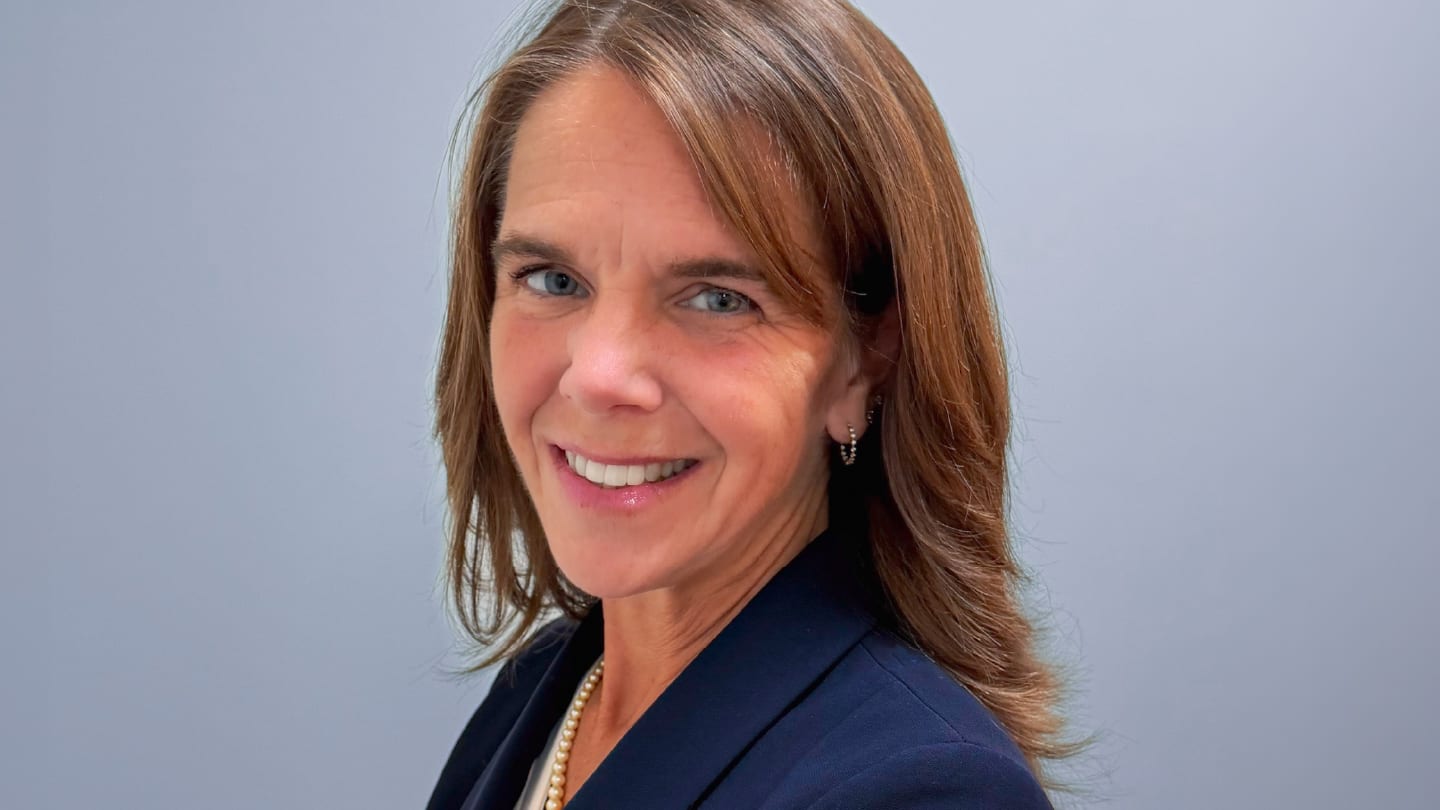
Sitting Down With… Erin Chambers, Vice President and General Manager, Consumables and Lab Automation, Waters Analytical Sciences, Waters Corporation
Did you always want to be a scientist?
I have always been fascinated by science. My grandfather was a chemist and once had a laboratory in his basement. I remember going downstairs, seeing all the bottles lining the shelves, and being instantly captivated by the whole scene.
The dynamic nature of science itself has always inspired me. I am in awe of it every day, and that natural curiosity is really what drives me. My undergraduate degree was in chemistry, and I later completed my PhD in analytical chemistry while working full-time and raising my two young children. One of my strongest memories is writing my dissertation while two very young kids were running around the house as I tried to concentrate.
There was also a practical consideration early on. I wanted to start working and pay off my student loans, which is why I did not go straight into a PhD. But most importantly, I was drawn to the drug development process. I wanted to be on the front lines, to understand how medicines are developed, the different stages involved, and what goes into each one.
I started my career in drug development at Pfizer, where I ran studies and watched molecules evolve through successive iterations. I found it fascinating to observe how even small changes affected their behavior. I later worked as a mass spectrometry service engineer and in mass spec instrument development, as well as spending some time in sales.
I have now been at Waters for more than 26 years. I started in applications, focusing on quantitative bioanalysis, which at the time primarily meant small-molecule bioanalysis. Over the years, I progressed from being an applications scientist to managing increasingly larger scientific teams, which allowed me to influence the science more broadly.
Every day brings something different, and that part never wears off.
What drew you from drug development into analytical instrumentation?
I’m not sure I thought of it as a deliberate move at the time. I remember moments at Pfizer when we had one of the very first triple quadrupole mass spectrometers. At the time, they were floor-standing instruments, about the size of a chest freezer. I could hear the ka-chunk, ka-chunk of the cryopumps, and I became curious about how the instrument worked. I would stay late with the service engineers, listen to what they were doing, and try to learn. As someone who was naturally curious and liked fixing things, I began to wonder whether it was something I could do as well.
That transition into analytical instrumentation really grew out of wanting to understand how these instruments worked. How is it possible to separate molecules by mass-to-charge ratio and produce such definitive, sensitive analyses? Again, it came back to curiosity and the desire to learn more.
Would you say your work has been driven more by impact or curiosity?
It’s something that has changed over the course of my career. For the first part, it was almost entirely about scientific curiosity. But as I’ve matured, developed as a leader, and gained a broader sphere of influence, it has become much more about the impact of what we are doing. When I talk to people outside work, they are not always especially interested in the science itself, but they do care about what the science makes possible. When you translate the science into impact, it becomes meaningful to many more people.
We cannot develop something like the next antibody-oligonucleotide conjugate unless we can characterize it, understand its impurities, and determine what those impurities ultimately mean for the person taking the medicine. That can only happen if we develop the right tools.
You look at something like Zolgensma, and its ability to treat a devastating childhood disease – it doesn’t get much more impactful than that. But it is critically important to detect even slight molecular differences because of the potential impact on safety and efficacy.
How have the pace and demands of innovation changed over the course of your career?
The demands on innovation in this space are greater than ever. At almost any given time, someone will claim things are more complex than they were before, especially compared with the days of using an isocratic pump, measuring peaks on paper, and weighing them. But I would absolutely say that moving from synthetic molecules to medicines produced in biological systems represents a genuine step change.
Biology is inherently unpredictable. It’s a major reason why the industry has become so much more complex. We understand controlled synthetic reactions reasonably well, but when medicines are created in biological systems, they generate much more variability. One of the new challenges is separating the biological manufacturing process from the product itself, and understanding how that process affects the final medicine. That was not something we had to worry about in the same way with synthetic molecules.
You can see that progression from small synthetic molecules such as aspirin and ibuprofen, to molecules that can still be synthesized, including peptides and short oligonucleotides, then to antibodies produced in bioreactors, and finally to cell therapies. Alongside that progression, the sheer diversity of biotherapeutics is striking, from antibody-based formats to adeno-associated viruses and lipid nanoparticle delivery systems.
As a result, the days of changing a single variable or improving a single dimension are gone. Molecules of this complexity require simultaneous innovation across multiple dimensions. In chromatography, it is no longer enough to innovate around particle physics or surface chemistry alone. You have to understand the interplay between surface chemistry, particle morphology, and physics, and improve them together.
Customer needs are also changing. Companies need to release batches of increasingly complex medicines quickly, but quality-control tests can take too long or fail to resolve the subtleties needed to ensure safety. We watch where investment is going, follow development pipelines, and track scientific breakthroughs in the literature. There are many different indicators, but when we start to see the same need emerging across multiple customers, that is when we know it is more than a passing trend and requires our focus.
What scope is there for further innovation in column technology?
We are a long way from exhausting the opportunities to innovate. The next advances will come from being willing to challenge the status quo rather than simply iterating within existing constraints. We need to look at pulling new levers and, importantly, pulling multiple levers at the same time.
In some ways, that mirrors what is happening across the wider industry. Column and sample preparation technologies began with silica, then moved into hybrid particles. The next frontier is combining chemistry and biology within columns and sample preparation devices.
Innovation will continue across well-established dimensions, including particle engineering, surface chemistry, and physics. But it will also come from combining those chemical capabilities with biological approaches, particularly affinity. That might involve immobilizing a biological ligand on a chemical substrate and then optimizing both elements, along with the different variables within each.
The runway is very long, and it is not only about the materials or chemistry; it’s also about form factor. Today, we think of a stainless-steel column. Tomorrow, it could be a small snap-in device, a microfabricated format, or a chip. There is a great deal of room for innovation across multiple dimensions, and all of it will increasingly involve automation.
Are there any lessons you've learned about how to make innovation happen, and how to sustain it?
I think there is always room for blue-sky innovation. While the foundation of innovation is rooted in customer needs, customers do not always know exactly what they require. There also has to be room for our scientists to explore evergreen needs: more sensitivity, more resolution, something smaller, or something faster. Twenty years ago, nobody ever said, “I want a computer that fits in my pocket.”
When we think about product development, we deliberately balance different kinds of innovation. One area is focused on extending proven technologies and developing them as far and as quickly as we can.
Then there is the high-risk, high-reward category, what some of our leaders call the “grand challenges.” That is where scientists need the freedom to ask bigger “what if?” questions, such as whether we could understand what drives efficacy much earlier or solve a problem that customers have not yet fully articulated.
Our role is then to ask whether those ideas are commercially viable, and where we should place our bets. With that in mind, I hesitate to describe customer-focused innovation as constrained. It certainly provides direction, but you also have to leave room for blue-sky thinking.
Who do you need around the table to turn an innovative idea into a successful product?
For me, building teams for innovation starts with creating the right blend of people. Some are inherently creative and abstract; they can think big and identify those “what if?” moments. Others are extremely methodical and bring structure to the process. Ultimately, you need both to be successful.
The early ideation stage, where you are deciding which big problems to pursue, requires creativity and unconstrained thinking. But once you move into product development and start doing fundamental parameter testing in a controlled, regulated environment, you need people who are highly methodical and analytically focused. That is especially important for us because customers depend on these tools for quality and reliability, often in highly regulated environments.
We need analytically minded people who ensure that, when we release a product, it is ready to meet regulatory expectations. At the same time, the extraordinary advances happening in bioseparations demand creativity. They require people who can connect diverse systems and imagine new ways to innovate.
What can leaders do to create a culture in which innovation thrives?
There are a few philosophies I live by. The first is to trust the team: hire people who are smarter than you are, and trust them to do their jobs. I actively look for people who are operating at the cutting edge who have more knowledge about a particular area than I do. These are people our customers trust, and I trust them too.
Sometimes it is as simple as bringing in that expertise, providing direction, and then letting people shine by getting out of the way. That is one of my core leadership philosophies. I think it is essential not only for building an innovative team, but also for sustaining the energy and passion that innovation requires.
The second is to build a leadership team that thinks differently from you. Human nature is to surround yourself with people who are like you, but in innovation – and R&D environments in particular – you cannot afford to do that. You need diversity of thought: people who are analytical and methodical, people who are willing to take decisive action with imperfect data, and people who think creatively. You need all of those perspectives, and you have to be deliberate about building that diversity of thought.
I once worked with someone who would take a very long time to respond to a question in meetings. I tend to make decisions quickly, so I found it frustrating at first, but I then stepped back and realized how important it was to have that system of checks and balances. From then on, I became much more purposeful about surrounding myself with people who think differently.
The third principle is that, as a leader, you have to be optimistic. Adopt the mindset that there is no challenge that cannot be overcome, and that you will find a way through it. As the old saying goes, if it were easy, everyone would do it.
Those are the principles I try to live by: bring in great people, trust them, create space for different kinds of thinking, and do not extinguish their passion to innovate.
Are there any final thoughts or reflections you’d like to leave us with?
I think it comes back to one of the themes we discussed at the beginning. Our role has fundamentally shifted from acquiring good data to answering questions. It is not enough simply to generate data anymore; the aim is to use that data to answer something meaningful.
Once you can trust the data, you can ask bigger questions. You can move beyond worrying about whether you detected everything in a chromatographic run, whether the peak area is accurate, or whether some of the analyte was lost to binding. Instead, you can ask what is affecting the efficacy of a molecule, what its safety profile looks like, and how the biology connects.
That is where analytical technology can have real impact. The development, safety, and release of life-saving medicines can only progress at the pace of the tools available.
Newsletters
Receive the latest analytical science news, personalities, education, and career development – weekly to your inbox.