Objective:
The article examines the objective, findings, and clinical context described in A Glimpse into the Future of Analytical Instrument Design?.
Approach:
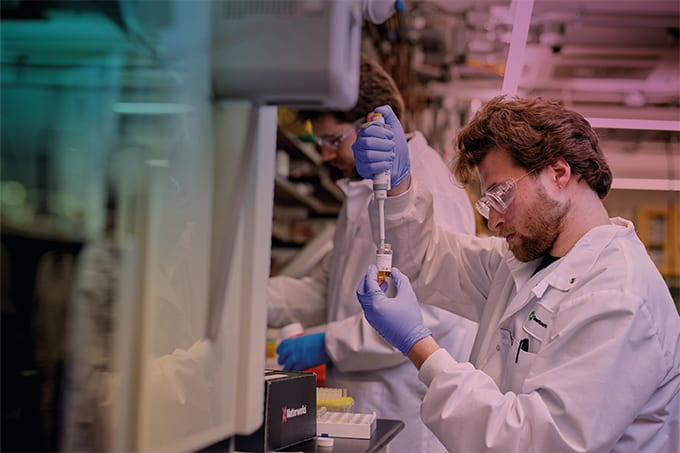
- Development: The system evolved from academic projects in computational imaging and machine learning, including BlurryScope, into a scanner intended for routine pathology use.
- Image acquisition and reconstruction: Unlike conventional stop-and-stare scanners, SCANIMUS records video during continuous stage movement at about 10–20 mm/s. An image-to-image AI model is trained using paired fast, blurred scans and much slower, high-quality reference scans to reconstruct sharp …
- Alternative mode and robotics: A slower stop-and-stare mode is also available, though the interviewee says it does not match high-end commercial scanners’ throughput. Robotic features can record user interactions and may support personalized workflows and automation.
Key Findings:
- The interviewee reports that computational reconstruction can reliably recover sharp images from fast, motion-blurred scans.
- The system is designed to be compact and straightforward to integrate into pathology workspaces.
- The interviewee notes that more than 90% of routine biopsies are not digitized, including in well-resourced healthcare systems.
- The proposed design principle is to co-design acquisition and reconstruction, accepting controlled, characterized imperfections rather than optimizing optics, mechanics, and computation independently.
Interpretation:
The interviewee argues that computation can be incorporated into the measurement process itself, provided the acquisition imperfections are controlled and characterized. Reconstructed images should be treated as derived measurements, with raw data retained and validation including reference comparisons, testing beyond training conditions, failure-mode stress tests, application-level metrics, uncertainty assessment, and data provenance.
Limitations:
- The context is an interview and does not provide quantitative performance results or independent validation data.
- The slower stop-and-stare mode uses more modest hardware and a smaller camera and is described as having lower throughput than high-end commercial scanners.
- The source text ends mid-sentence after “In our BlurryScope,” so further details on validation are unavailable.
Conclusion:
SCANIMUS illustrates a scanner architecture that pairs continuous acquisition with AI-based reconstruction. The interviewee emphasizes that this approach is not a claim that software can repair arbitrarily poor measurements.
Sources:
This content is an AI-generated, fully rewritten summary based on a published scholarly article. It does not reproduce the original text and is not a substitute for the original publication. Readers are encouraged to consult the source for full context, data, and methodology.
Newsletters
Receive the latest analytical science news, personalities, education, and career development – weekly to your inbox.
About the Author(s)
Helen Bristow
Combining my dual backgrounds in science and communications to bring you compelling content in your speciality.
James Strachan
Over the course of my Biomedical Sciences degree it dawned on me that my goal of becoming a scientist didn’t quite mesh with my lack of affinity for lab work. Thinking on my decision to pursue biology rather than English at age 15 – despite an aptitude for the latter – I realized that science writing was a way to combine what I loved with what I was good at. From there I set out to gather as much freelancing experience as I could, spending 2 years developing scientific content for International Innovation, before completing an MSc in Science Communication. After gaining invaluable experience in supporting the communications efforts of CERN and IN-PART, I joined Texere – where I am focused on producing consistently engaging, cutting-edge and innovative content for our specialist audiences around the world.