Researchers have developed a new technique – laser-emission vibrational microscopy (LEVM) – that can perform more than 2,000 microscale viscosity measurements in just 25 minutes. The method uses picoliter droplets of blood as optical microcavities and reads out their mechanical properties by tracking fluctuations in laser emission, providing a high-throughput alternative to conventional lipid assays and bulk rheology tools.
We spoke with Chaoyang Gong, co-author of the study and researcher at the School of Optoelectronic Engineering, Chongqing University, China, about the inspiration behind the work, the analytical challenges the team faced, and what laser-driven droplet vibrations could mean for the future of clinical screening.
What inspired this research?
Part of the inspiration actually came from a simple everyday scene – watching how soap bubbles vibrate when a child blows on them. We realized that microdroplets behave in a similar way: they are miniature optical cavities whose vibrations carry rich mechanical information. This observation motivated us to explore whether such droplet vibrations could be turned into a practical, high-throughput diagnostic tool.
What was the main limitation of existing diagnostic or rheological methods that your work set out to overcome?
Conventional rheometers require milliliter-scale samples, have low throughput, and cannot resolve microscale heterogeneity. Biochemical lipid tests, while accurate, are multi-step, slow, and destructive. Existing optical microrheology techniques tend to be limited by low sensitivity, long acquisition times, or complex instrumentation. Our goal was to overcome these bottlenecks by enabling fast, microscale, and massively parallel viscosity measurements directly from trace-volume clinical samples.
Can you explain how this LEVM-based approach works?
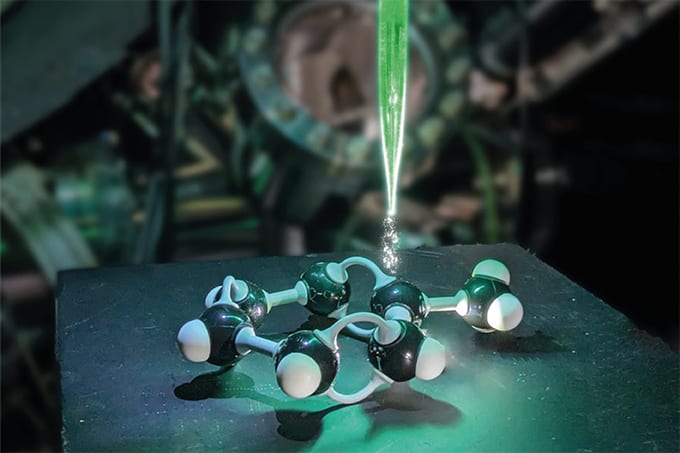
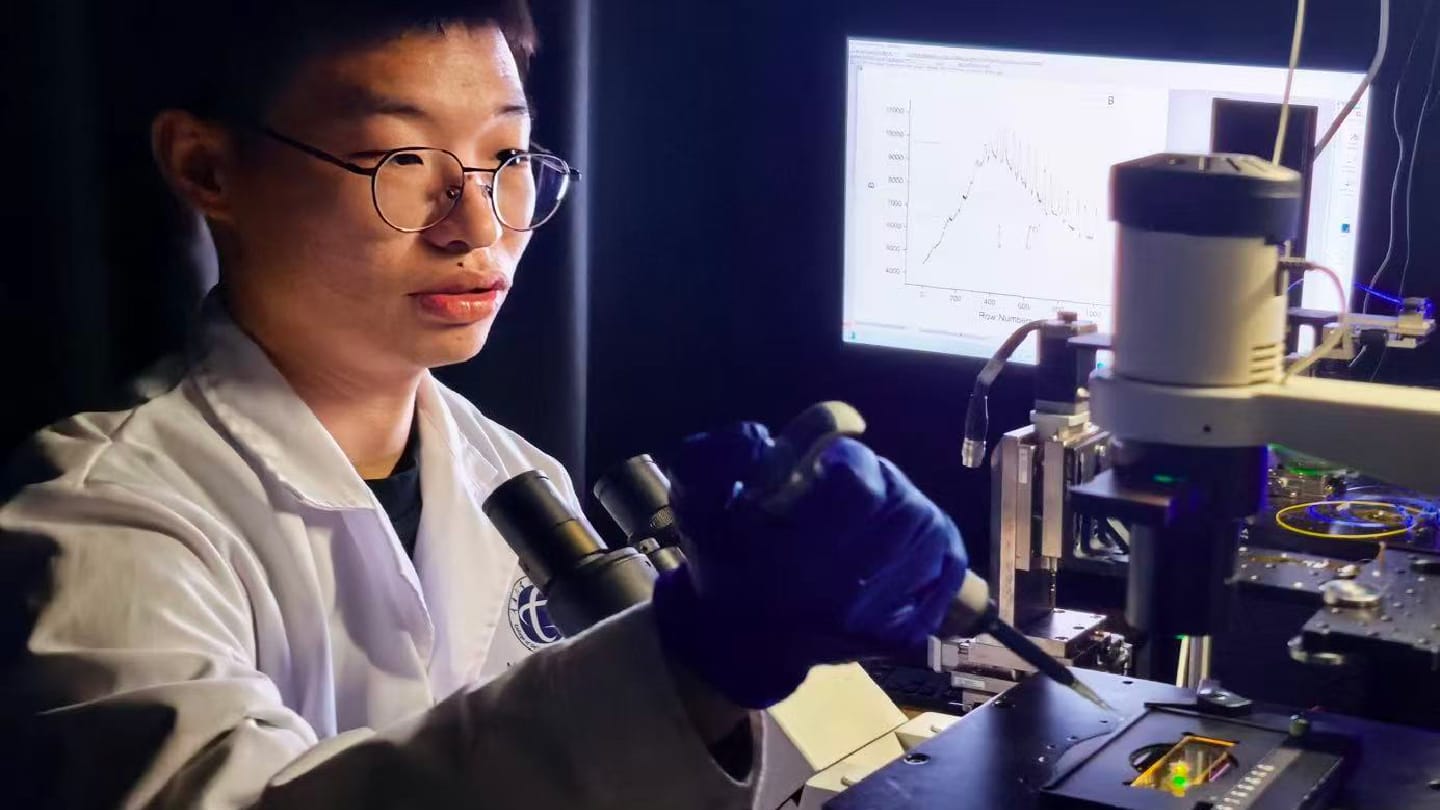
We dispense human serum using a commercial inkjet printer, generating thousands of picoliter-scale microdroplets. These droplets, which naturally support whispering-gallery modes, are massively fabricated on a hydrophobic surface. When excited by a pump laser, each droplet acts as a microlaser. Ultrasound-induced mechanical vibrations deform the droplet cavity, resulting in oscillatory shifts and intensity fluctuations in the emission spectrum. By tracking these frequency shifts with high precision, we quantify the droplet’s vibrational response, which is tightly correlated with viscosity. By integrating stage scanning, our approach enables rapid mechanical profiling of thousands of droplets in parallel.
What were the biggest analytical or technical challenges in developing and validating this high-throughput system?
One of the key technical challenges was extracting the vibration signals of individual microdroplets from their time-resolved laser emission spectra. Because the sampling rate was far lower than the ultrasound excitation frequency, the system could not directly resolve the droplets’ vibration frequencies. For example, in our experiment the ultrasound frequency was 132.4 kHz. The pulsed laser samples the continuous waveform of ultrasound at a 20 Hz repetition rate, producing a sequence of discrete values that constitute a lower-frequency waveform. We found that the undersampling effect distorts the frequency components of ultrasound, while the standard deviation (SD) of the undersampling signals remains consistent with the original signal. This allowed us to bypass the frequency-resolution barrier and use the SD as a reliable indicator of each droplet’s mechanical properties.
What does this higher throughput mean for the future of clinical diagnostics?
We demonstrated the concept by using a commercial inkjet printer for massive fabrication of liquid droplets, which requires at least 1 milliliter of sample per printing run. However, because each microdroplet is extremely small, a single drop of blood could theoretically provide more than seven million individual measurements.
Achieving more than 2,000 measurements in just 25 minutes opens the door to a new generation of clinical diagnostics. While the technique does not directly quantify lipid subtypes like traditional enzymatic assays, LEVM enables real-time, high-throughput lipid assessment that can support earlier detection of hyperlipidemia in clinical settings. When combined with conventional lipid panel tests, this approach provides a more comprehensive picture of an individual’s cardiovascular health.
What are the next steps toward translating this technology from “bench to bedside?”
The next steps toward translating this technology into real-world diagnostics focus on two main directions. First, it is essential to increase the number of tested blood samples to establish more robust and accurate correlations between microdroplet viscosity and hyperlipidemia. This will improve the reliability of the measurements and strengthen the clinical relevance of the mechanical biomarkers. Second, we aim to integrate the acoustic stimulation and optical detection components into a fully functional, compact instrument. Such integration will enable automated, user-friendly operation suitable for point-of-care applications, transforming the laboratory setup into a practical diagnostic tool.
Newsletters
Receive the latest analytical science news, personalities, education, and career development – weekly to your inbox.