“AI is not only a tool for automation; it is also a mirror – exposing where our field has relied on tacit knowledge, intuition, and poorly defined objectives.”
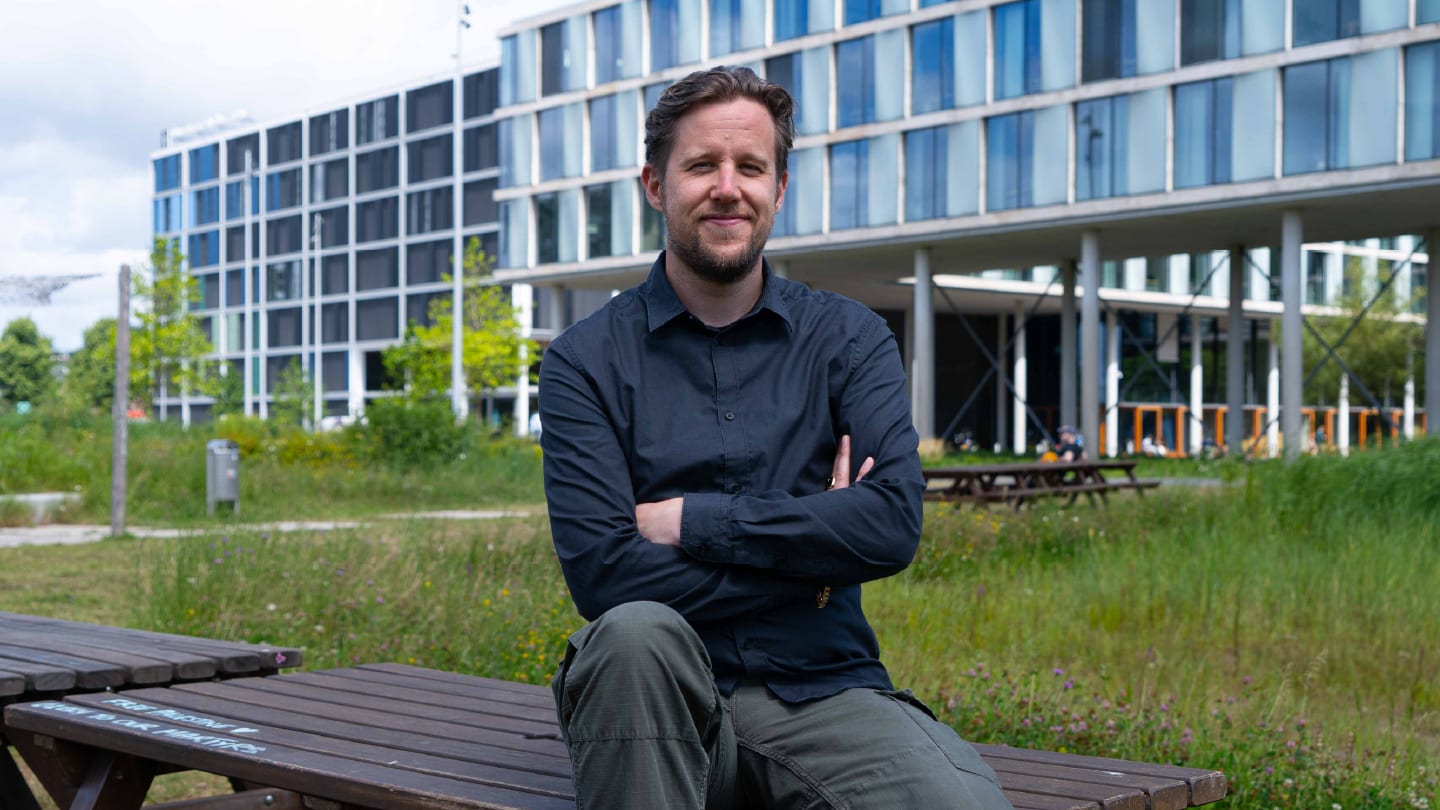
What does your research focus on, and what problem are you trying to solve?
I develop analytical solutions, mainly using chromatography, for partners working on societal and industrial challenges. At heart, I am a chromatography lab practitioner, but I combine fundamental chromatographic research with computational sciences, including AI and automation, because these tools are increasingly needed to push the limits of what chromatography and mass spectrometry can answer.
What aspect of your current research excites you most – and why is this an important moment for it?
What excites me most is the advent of autonomous laboratories and learning analytical workflows. We are reaching a point where instruments, software, data, and human expertise can be connected in a much more meaningful way. Instead of treating each experiment as isolated, we can build systems that learn from previous data, understand what has already been tried, suggest what should be done next, and help us decide whether an analytical method is genuinely fit for purpose.
This is an important moment because analytical science has developed beautiful and extremely sophisticated technologies, but many of them are still difficult to use outside expert environments. Autonomous and AI-assisted workflows could help make these technologies more accessible to society: in environmental monitoring, health, food, materials, sustainability, and many other areas where better chemical information is urgently needed.
At the same time, I do not believe analysts can or should be replaced. Analytical chemistry is not just operating an instrument or optimizing a number. It involves defining the question, understanding the sample, recognizing when data are misleading, deciding what level of evidence is sufficient, and judging whether an answer is useful in the real world. AI can help us search, remember, optimize, and connect information, but the analyst remains essential because scientific judgment, skepticism, and responsibility cannot simply be automated.
Looking five to 10 years ahead, what emerging trend do you think will have the greatest impact on analytical science?
I think the greatest impact will come from autonomous and self-learning analytical laboratories. Not automation in the narrow sense of replacing manual labor, but systems that can reason across previous experiments, instruments, datasets, and objectives. The real transformation will be the creation of analytical environments with a kind of shared memory: systems that know what has been tried before, what worked, what failed, under which conditions, and for which analytical purpose.
This could change method development profoundly. Today, much expertise remains implicit in the minds of individual researchers or hidden in notebooks, instrument methods, and scattered datasets. If we can capture and structure that knowledge, future analytical workflows can become more reproducible, transferable, and efficient. The promise is not that science becomes push-button, but that researchers spend less time rediscovering what is already known and more time asking better questions.
What is the biggest challenge facing analytical science today?
I do not think the biggest challenge is simply that samples or data are complicated. They have always been complicated. What has changed is that our instruments now reveal more of that complexity, which creates more questions and makes it harder to decide what actually matters.
To me, the central challenge is defining what we want. How do we mathematically capture analytical objectives across the diverse questions we encounter in health, environment, food, forensics, energy, materials, and industry? What does “good enough” mean when the goal may be quantification, classification, discovery, comparison, compliance, diagnosis, or understanding?
This is also why AI has become scientifically interesting to me. Extremely powerful algorithms already exist, but in chromatography they are often difficult to use well because we cannot always define the objective precisely enough. The limitation is not only computational; it is analytical and conceptual.
A second challenge is how we combine data reliably. We increasingly want to fuse information from different instruments, experiments, laboratories, and historical datasets. That is powerful, but it can also import hidden assumptions.
Bias is a notoriously quiet enemy in analytical science, and therefore all analytical scientists are taught about it at a very early stage: bias does not only distort our answers; it can teach our future systems the wrong questions.
For that reason, I do not think the field urgently needs more sophisticated instrumentation above all else. In many areas, we already have more instrumental sophistication than we can fully use. The bottleneck is increasingly in defining objectives, structuring knowledge, combining data, validating decisions, and making powerful analytical capabilities robust enough to be trusted beyond the laboratory that developed them.
Do you have any strong opinions with which the rest of the field tends to disagree?
One strong opinion I have is that the desire for a “ChatGPT for chromatography” is, at least in its simplest form, based on the wrong expectation. Large language models are impressive because language contains enormous amounts of structured human intent. Chromatography is different. The hard part is often not generating a plausible answer, but defining the analytical objective, understanding the sample, choosing the right compromise, and validating whether the method is fit for purpose. I think we sometimes overvalue instrumental sophistication and undervalue the clarity of the analytical question. A more advanced method is not automatically a better method. A method is only powerful if it answers the right question, with the right level of confidence, for the right context.
So I am very excited about AI in chromatography, but not because I expect a model to replace the chromatographer. I am excited because AI forces us to ask fundamental questions again: What are we optimizing? What do we mean by resolution, selectivity, robustness, information, or fitness for purpose in a specific context? How do we encode expert decisions? How do we prevent previous data from biasing future method development?
In that sense, AI is not only a tool for automation; it is also a mirror – exposing where our field has relied on tacit knowledge, intuition, and poorly defined objectives. That is uncomfortable, but scientifically very productive.
What decision, opportunity, or unexpected event has had the greatest influence on your career so far?
The most influential “decision” in my career was perhaps not a single decision at all, but a recurring willingness to follow the analytical problem wherever it led. I was trained as, and still feel very much like, a chromatography lab practitioner. I like the craft of chromatography: the columns, the gradients, the instruments, the strange satisfaction of gradually making a difficult separation work.
But again and again, the problems I wanted to solve pushed me beyond the instrument itself. I encountered all these models and relationships in our community’s literature. Great minds developed methods to predict and optimize separations before I was even born!
To make chromatography more powerful, more reliable, and more useful for complex societal questions, I found myself moving toward chemometrics, automation, software, data science, and now AI. That was not because I wanted to leave chromatography behind, but because I wanted to understand what chromatography could become if we connected it to the right computational tools.
So the greatest influence on my career has been the opportunity to work at that interface: between hands-on separation science and computational thinking. It has changed how I see the field. I no longer think of analytical chemistry only as developing better methods, but as developing better ways of asking questions, learning from experiments, and making chemical information useful to society. This sometimes leads to strange questions that we ask ourselves in the lab. A good example is: “Did this experiment contribute more knowledge than it consumed resources?” If we factor in bias and the risk of using AI in the lab, one could even say: “Did this experiment contribute more knowledge than it consumed?” This is because a new measurement – remember, data analysis is part of any analytical workflow – can, in the event of mistakes, also lead to wrong conclusions and thus bias.
Who has changed the way you think about science – or life more broadly – and how?
Earlier in my career, I would probably have answered this question by naming mentors such as Peter Schoenmakers, Gabriel Vivo-Truyols, or Dwight Stoll, and their influence is still very real. They shaped how I think about chromatography, scientific rigor, collaboration, and ambition.
But today, I would say that the people who most actively change the way I think are the people in and around our team: PhD candidates, colleagues, students, and societal partners. They are not shy about voicing critical opinions, and I value that enormously. They question assumptions, challenge priorities, and often see limitations or opportunities that I would otherwise miss.
That has changed how I think about science and leadership. Good science is not produced by surrounding yourself with people who agree with you. It comes from creating an environment where people feel responsible for the work and confident enough to disagree. My team and our partners continuously remind me that analytical science is strongest when expertise, criticism, creativity, and trust are all present at the same table.
Bob Pirok is Associate Professor at the University of Amsterdam, The Netherlands
Explore The Analytical Scientist 40 Under 40 Power List 2026
Newsletters
Receive the latest analytical science news, personalities, education, and career development – weekly to your inbox.