Conexiant
Login
  • The Analytical Scientist
  • The Cannabis Scientist
  • The Medicine Maker
  • The Ophthalmologist
  • The Pathologist
  • The Traditional Scientist
The Analytical Scientist
  • Explore

    Explore

    • Latest
    • News & Research
    • Trends & Challenges
    • Keynote Interviews
    • Opinion & Personal Narratives
    • Product Profiles
    • App Notes
    • The Product Book

    Featured Topics

    • Mass Spectrometry
    • Chromatography
    • Spectroscopy

    Issues

    • Latest Issue
    • Archive
  • Topics

    Techniques & Tools

    • Mass Spectrometry
    • Chromatography
    • Spectroscopy
    • Microscopy
    • Sensors
    • Data and AI

    • View All Topics

    Applications & Fields

    • Clinical
    • Environmental
    • Food, Beverage & Agriculture
    • Pharma and Biopharma
    • Omics
    • Forensics
  • People & Profiles

    People & Profiles

    • Power List
    • Voices in the Community
    • Sitting Down With
    • Authors & Contributors
  • Business & Education

    Business & Education

    • Innovation
    • Business & Entrepreneurship
    • Career Pathways
  • Events
    • Live Events
    • Webinars
  • Multimedia
    • Video
    • Content Hubs
Subscribe
Subscribe

False

The Analytical Scientist / Issues / 2026 / May / Measuring Aerosol Chemistry in Minutes
Spectroscopy Sensors Environmental

Measuring Aerosol Chemistry in Minutes 

Nanoelectromechanical FTIR analyzes nanogram-scale aerosol samples, reducing collection times from week-long campaigns to minutes

05/07/2026 3 min read
  • Full Article
  • Summary
  • Takeaways
  • Listen
  • Quiz
  • Poll

Share

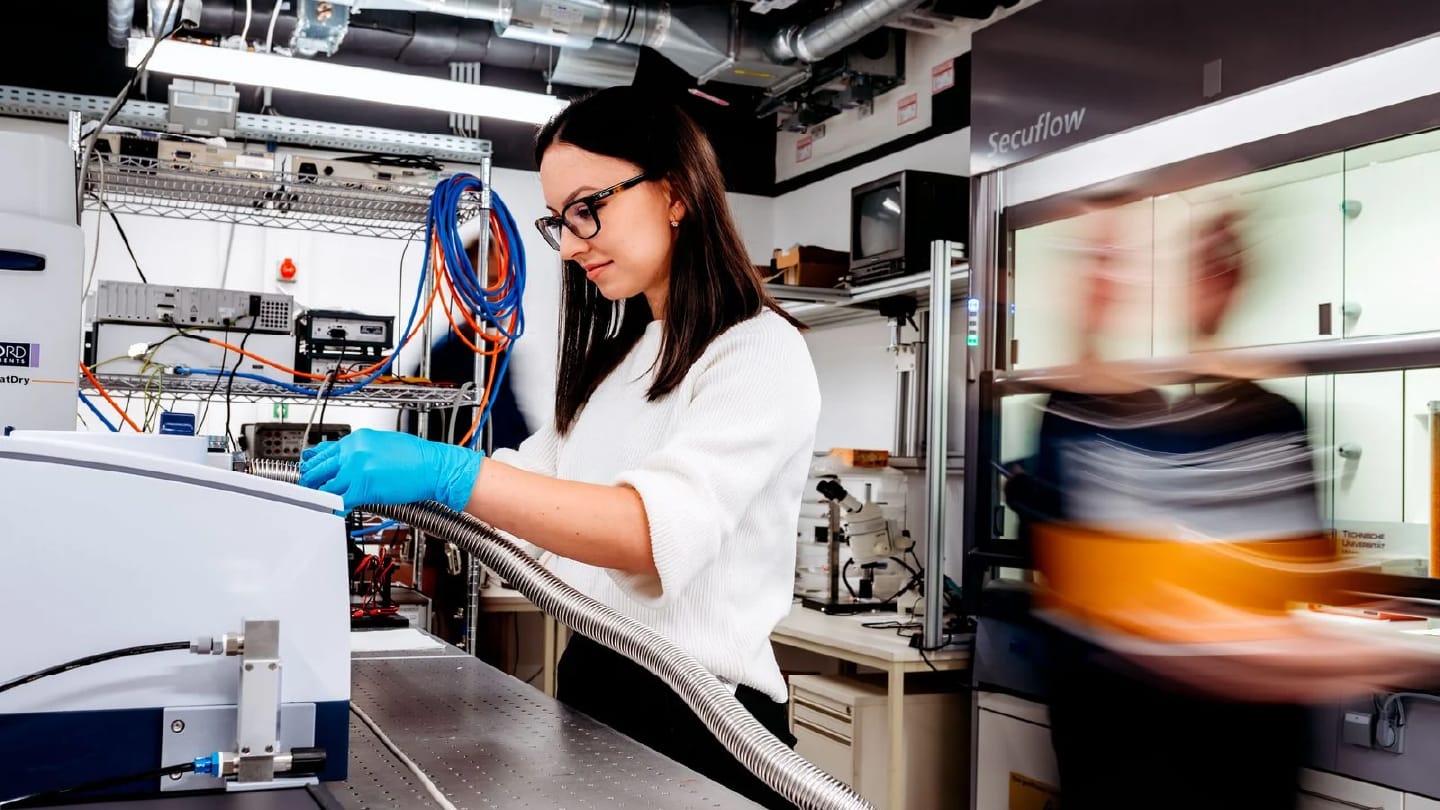
Caption: Jelena Timarac Popovic Credit: Romana Maalouf Photography

A nanoelectromechanical infrared sensing workflow has shown that submicrometer aerosol chemistry can be measured from nanogram-scale samples, reducing collection times that often stretch across days or weeks to as little as minutes. 

The approach, developed by researchers at TU Wien, EPFL, and Invisible-Light Labs, combines nanoelectromechanical systems with Fourier transform infrared spectroscopy (NEMS-FTIR). Instead of relying on conventional filter collection, airborne particles are deposited onto ultrathin silicon nitride resonators that act as both sampling substrate and detector. 

The membrane-based method extends infrared detection to very low particle masses. When particles on the membrane absorb infrared light, they heat slightly, changing the membrane’s vibrational frequency. That photothermal response can then be used to quantify chemical components such as organic functional groups, ammonium sulfate, and equivalent black carbon.  

In the study, the team applied NEMS-FTIR to submicrometer atmospheric aerosols, an analytically difficult fraction because of its small size and low mass. Calibration experiments showed strong agreement between NEMS-FTIR spectra and reference measurements for ammonium sulfate and organic functional groups. Reported detection limits for organic functional groups ranged from 1.3 to 5.4 ng, roughly three orders of magnitude lower than previous PTFE-filter FTIR methods. 

That sensitivity translated into much shorter sampling times. In urban conditions, the researchers estimate that 15–20 minutes of sampling is enough to exceed detection limits, while low-mass Arctic aerosol environments can be characterized on timescales of hours rather than week-long filter collections. 

Field demonstrations in Vienna, Sion, and Greenland showed that the method could capture short-term changes in aerosol composition. At Villum Research Station in Greenland, the compact sensor was also deployed on a tethered balloon, allowing chemical profiles to be measured above the surface layer. 

“Thanks to the high sensitivity of our method, Julia Schmale’s team can analyze the chemical composition of particles with high temporal resolution,” said Josiane Lafleur, CEO of Invisible-Light Labs, in a recent press release. “It is now possible, using tethered balloons, to observe how the chemical composition of aerosol particles changes over short timescales and how it varies between ground level and higher altitudes – something that was practically impossible with previous methods.” 

Further validation across more aerosol types and field conditions will help determine how broadly NEMS-FTIR can complement established aerosol mass spectrometry and filter-based spectroscopy methods. 

Newsletters

Receive the latest analytical science news, personalities, education, and career development – weekly to your inbox.

Newsletter Signup Image

False

Advertisement

Recommended

False

Related Content

The Analytical Scientist Innovation Awards 2024: #3
Spectroscopy
The Analytical Scientist Innovation Awards 2024: #3

December 6, 2024

4 min read

Bruker’s multiphoton microscopy module, OptoVolt, ranks third in our Innovation Awards. Here, Jimmy Fong, product development lead, walks us through the major moments during development.

More Bang for Your Buck
Spectroscopy
More Bang for Your Buck

December 4, 2024

1 min read

Researchers develop more stable catalysts for dry reforming of methane – a promising method for carbon capture and utilization (CCU)

The Analytical Scientist Innovation Awards 2024: #1
Spectroscopy
The Analytical Scientist Innovation Awards 2024: #1

December 10, 2024

2 min read

And the technology ranked first in our 2024 Innovation Awards is…

The Analytical Scientist Innovation Awards 2024
Spectroscopy
The Analytical Scientist Innovation Awards 2024

December 11, 2024

10 min read

Meet the products – and the experts – defining analytical innovation in 2024

Affiliations:

Specialties:

Areas of Expertise:

View Full Profile Follow
Contributions:

False

The Analytical Scientist
Subscribe

About

  • About Us
  • Work at Conexiant Europe
  • Terms and Conditions
  • Privacy Policy
  • Advertise With Us
  • Contact Us

Copyright © 2026 Texere Publishing Limited (trading as Conexiant), with registered number 08113419 whose registered office is at Booths No. 1, Booths Park, Chelford Road, Knutsford, England, WA16 8GS.