Inside Influenza's Playbook
Cross-linking MS and structure modeling capture viral–host interactions directly in infected intact cells.
A customized in-cell cross-linking mass spectrometry workflow has mapped direct influenza–host protein contacts without disrupting cellular architecture, clarifying how the virus co-opts host machinery for hemagglutinin processing and disperses nuclear paraspeckles.
The workflow fixes proteins while their native compartments remain intact, preserving transient and location-specific contacts that can be lost or artificially created after cell lysis. “XL-MS allows us to capture protein-protein interactions directly in infected intact cells, while also providing structural information about how these interactions are happening,” said Boris Bogdanow, a study collaborator now at Charité – Universitätsmedizin Berlin, in a press release.
Cross-linked peptides were analyzed by mass spectrometry, and the resulting distance constraints were fed into a modified AlphaFold workflow to model how selected viral and host proteins fit together. The interaction map traced hemagglutinin through the cell’s protein-folding and trafficking machinery, identifying host factors involved in its maturation. Follow-up glycoproteomics and perturbation experiments linked several of those proteins to changes in hemagglutinin processing.
In the nucleus, another interaction network centered on paraspeckles, membraneless compartments containing RNA-binding proteins. Imaging showed that influenza infection consistently dispersed these structures across the cell lines and viral strains tested, potentially releasing factors that support viral replication.
“What surprised us most was the paraspeckles,” said first author Iuliia Kotova. “Watching these tiny organelles in the nucleus dissolve, consistently across every cell line and every flu strain we tested, told us this isn't a side effect of infection – it might be a strategy.”
Applying the workflow at multiple time points could distinguish contacts that initiate infection from those involved in later replication and host-cell reorganization.
“Although this study has focused on a lab-adapted strain, this study lays the groundwork to apply the methodology to viruses of potential pandemic relevance, such as H5N1, and for uncovering the interaction networks that support their multiplication in human cells,” said Bogdanow.
A Global Network for Dissolved Organic Matter
ENVnet reveals a conserved molecular core in dissolved organic matter alongside ecosystem-specific chemical signatures.
A new global tandem mass spectrometry resource, ENVnet, has shown that dissolved organic matter shares a conserved molecular core across environments while retaining signatures that reflect ecosystem type.
ENVnet combines negative-ion LC–MS/MS data from 1,389 samples spanning 13 terrestrial and aquatic environments. The collection includes 419 newly generated samples from underrepresented settings, including permafrost, peatlands, groundwater, tropical forests, and dryland soils, alongside 970 publicly available samples.
A central challenge was spectral chimerism: several molecules are often isolated and fragmented together, obscuring which product ions belong to each precursor. The team developed a mass-based deconvolution algorithm that separates these mixed events into molecule-specific spectra without prior structural knowledge. Applied to 5.6 million MS/MS spectra, the workflow produced 22,128 nonredundant molecular features, with 93 percent of inferred precursors independently supported by nearby MS1 signals.
A second algorithm, REM-BLINK, connected chemically related spectra using more than 100 mass differences associated with common dissolved-organic-matter transformations. The resulting network contained 8,874 features shared across multiple environments and 2,088 found in all of them. Phenolic acids, amino acids, isocoumarins, and dicarboxylic acids formed part of this common pool, while terpenoids contributed more strongly to environmental differences.
ENVnet also supported a model of microbial persistence trained on seven-day soil incubations. Using spectral and molecular-formula features, the classifier predicted whether compounds remained unchanged with 91 percent accuracy, identifying oxidation state as a major determinant of turnover.
Most ENVnet features remain structurally unresolved, with only 4.5 percent matching reference libraries. As more standards and environmental datasets are added, the resource should support higher-confidence annotation and more robust comparisons of dissolved organic matter across ecosystems.
Nanoplastics Reach Antarctic Soil
The first report of nanoplastics in mainland Antarctic soils points to local activity, redistribution, or long-range atmospheric transport.
Nanoplastics have been detected in mainland Antarctic soils for the first time, with six polymer classes found across the remote McMurdo Dry Valleys.
An international team led by Lancaster University developed an extraction protocol for particles between 20 nanometers and one micrometer, then analyzed them by thermal desorption–proton transfer reaction time-of-flight mass spectrometry. Heating releases polymer-specific products into the gas phase, enabling sensitive detection at sizes and concentrations difficult to reach with many microscopy and infrared methods.
Nanoplastics exceeded polymer-specific detection limits in 54 percent of 13 topsoil samples, reaching 295 nanograms per gram, and in two of four deeper-soil samples. Polypropylene accounted for the largest share of measured mass, alongside polyethylene, polyethylene terephthalate, polystyrene, polyvinyl chloride, and tire-wear particles. By contrast, microplastics above ten micrometers exceeded detection limits in only one of the 17 samples.
“This evidence shows that soils in one of Earth’s most pristine environments are not exempt from plastic contamination,” said lead author Nhu Phan in the team’s press release. “These findings highlight the urgent need to study plastic fate, transport and ecological impacts in polar regions.”
Atmospheric dispersion modeling pointed to several possible sources, including local research activity, redistribution of previously deposited material, and long-range transport from the Southern Ocean and lower latitudes. The study cannot yet distinguish among those routes, while incomplete recovery and ionization mean the reported concentrations should be treated as semi-quantitative lower bounds.
“At present, it is unclear whether ultrafine nanoplastic particles have arisen through direct long-range atmospheric transport from afar, or through the weathering of larger plastic debris found in marine areas along the Antarctic coastline,” said co-author Crispin Halsall.
Repeated atmospheric and soil sampling will be needed to separate new deposition from local fragmentation and resuspension.
A Broader Read on Bacterial Identity
The open web platform IDBac combines MALDI-TOF protein fingerprints, metadata, and metabolite profiles to distinguish bacterial isolates unresolved by 16S sequencing.
IDBac, an open web platform for MALDI-TOF bacterial identification and culture-collection analysis, links protein fingerprints with metadata and metabolite profiles to distinguish isolates that 16S rRNA sequencing can leave unresolved.
The platform combines a community-curated knowledgebase with web-based analysis tools. Its current reference collection contains spectra from 3,417 bacteria spanning 185 genera and seven phyla, with each accepted entry linked to at least 16S rRNA sequence data. Unknown isolates are compared with these references using an intensity-agnostic cosine distance score.
In a blind analysis of 18 human gut isolates, IDBac returned ten close matches in under five minutes,with follow-up 16S rRNA sequencing confirming the genus- and species-level assignments. Protein-spectrum dendrograms can also be overlaid with metadata, helping users examine how related isolates vary by factors such as sampling environment or collection time.
The platform extends beyond protein biotyping by analyzing specialized metabolites between 200 and 2,000 Da. Applied to 316 Burkholderiales strains, these metabolite association networks distinguished two isolates with identical 16S sequences but divergent chemical profiles. Whole-genome sequencing subsequently assigned them to different Paraburkholderia species.
The comparison prioritized the pair for fermentation and follow-up analysis. High-resolution mass spectrometry and NMR then supported the characterization of a previously unreported metabolite, haereoacidicolin, from one strain. Rather than replacing sequencing or structure elucidation, the MALDI screen helped direct those more intensive analyses toward the most informative strains.
The current metabolite workflow remains signal-based: MS1 data can flag differences but cannot distinguish isobars or assign structures directly. The authors are now expanding IDBac to accept tandem MS data, while broader community deposition should improve taxonomic coverage and make both bacterial matching and metabolite interpretation more robust.
(Mass) Spectacular and Strange
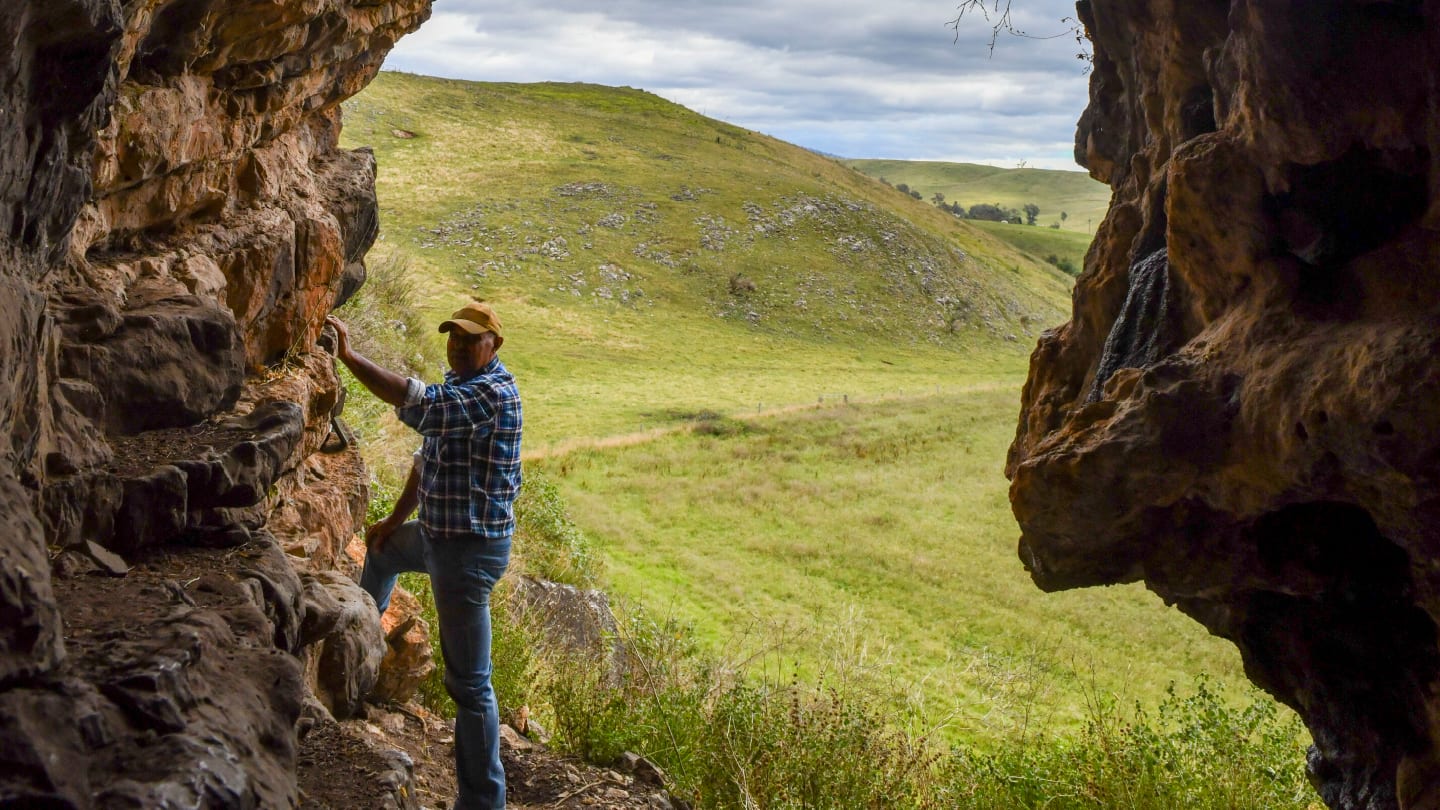
A Cave Record Written in Ash
Cloggs Cave, in GunaiKurnai Country in southeastern Australia, is known through GunaiKurnai cultural knowledge and 19th-century ethnographic records as a place associated with magic, healing, cursing, and spiritual practice. A new study suggests some of those practices left behind microscopic traces in ash.
To investigate how plants were used there, researchers analyzed phytoliths, microscopic silica bodies that form in plant tissues and can survive long after the plants themselves have decayed. Using optical microscopy, the team studied phytoliths from stratified cave sediments, as well as possum scats, which helped distinguish plant material introduced by animals from material brought in by people. The chronology was anchored by accelerator mass spectrometry radiocarbon dating, alongside optically stimulated luminescence dating, placing the plant-burning evidence within a sequence of cave use stretching back around 25,000 years.
“Here we show that the Old Ancestors selected whole grasses from the wider landscape and carried them into Cloggs Cave to spread out in thin layers and burn,” said Elle Grono, corresponding author of the study, in a Frontiers press release.
The key evidence came from burnt phytoliths in thin ashy layers. Because no plants grow inside the cave, those remains point to grasses being selected from the surrounding landscape, carried into the cave, spread out, and burned. Phytoliths from leaves, stems, flowers, and roots suggest that whole plants were brought inside.
Together with earlier finds, including a standing stone and fat-smeared wooden sticks, the burnt grasses suggest that ash was not just residue at Cloggs Cave, but part of the practice itself.
Newsletters
Receive the latest analytical science news, personalities, education, and career development – weekly to your inbox.