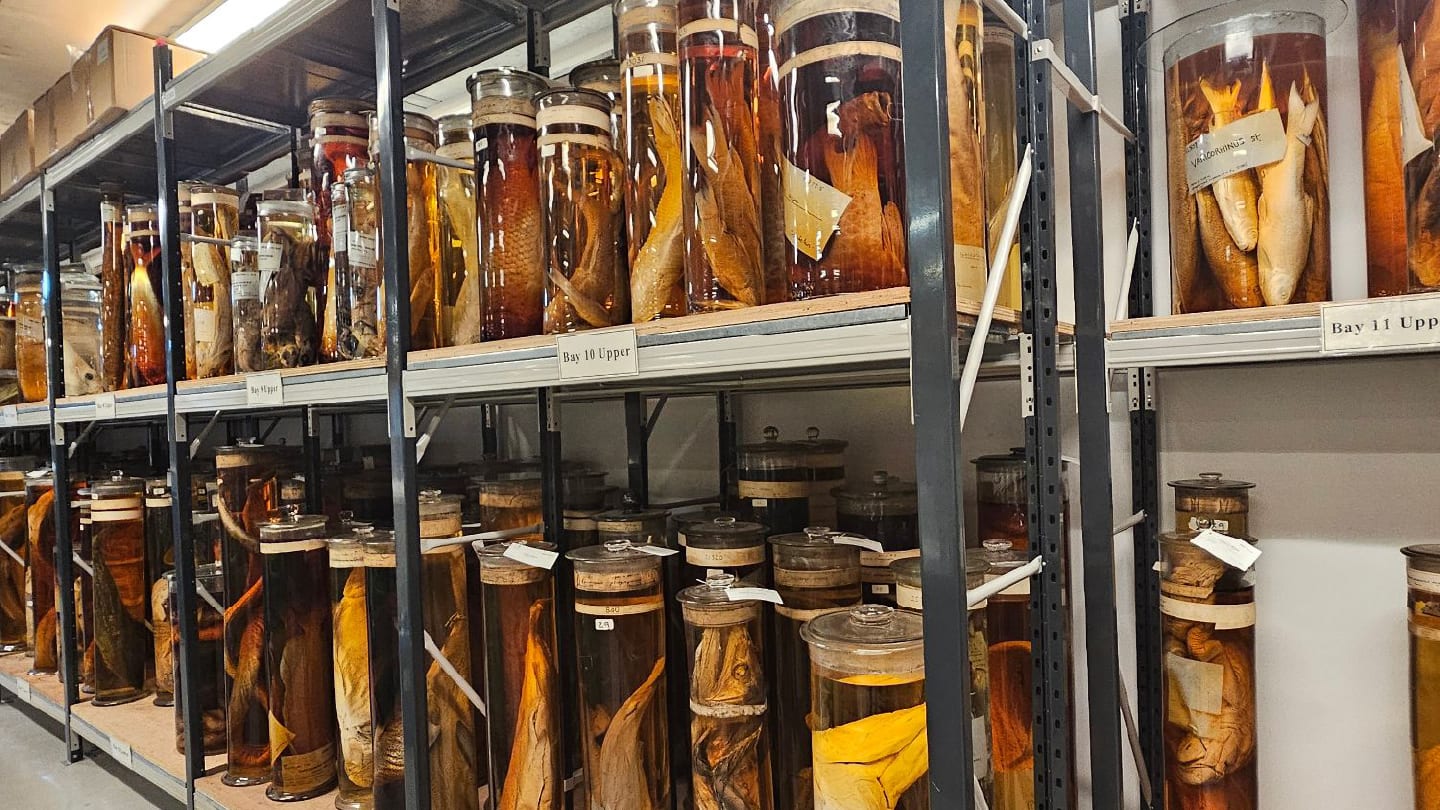
A portable Raman system designed to “see through” packaging has been adapted for heritage science, allowing curators to identify preservation fluids inside sealed wet specimens without opening the containers. Researchers report what they describe as “the first in situ chemical characterization of historical preservation fluids using the SORS method within a museum setting,” using spatially offset Raman spectroscopy (SORS) plus multivariate analysis.
The team analyzed 46 fluid-preserved biological specimens from the Natural History Museum (NHM), London, spanning different taxonomic groups and historical periods, including material dating back to the nineteenth century. Using a portable SORS instrument operated in “through-barrier” mode, the researchers correctly identified the preservation fluid in 78.5 percent of cases, with partial agreement in a further 15 percent. Only three samples (6.5 percent) were misclassified or could not be classified, typically because the fluid mixture was not represented in the reference library or because of strong fluorescence interference.
“This study presents the first in situ chemical characterization of historical preservation fluids using the SORS method within a museum setting,” the authors wrote. By subtracting non-offset from offset spectra, the method isolates the chemical signature of the fluid without opening the jar.
To cope with the diversity of historic formulations, the researchers built a calibration set of 20 mock-up preservation fluids, covering common excipients such as ethanol, methanol, glycerol, and formaldehyde, as well as more complex mixtures designed to mimic historical recipes including Bouin’s, Kaiserling III, and Steedman’s solutions. Historic museum specimens were measured directly through their containers, with multiple measurements taken at different positions to account for inhomogeneity and deposits on jar walls.
According to the authors, classification ambiguities “typically [arose] from fluorescence effects or secondary components not included in the calibration set.” Even in these cases, the method often identified the dominant solvent correctly, providing useful information for conservation planning. The technique also distinguished visually similar fluids, including variants of Bouin’s solution prepared in water versus ethanol, which appeared identical to the eye but showed distinct Raman signatures.
Beyond fluid identification, the study demonstrates that SORS can also extract information about the container material itself. By applying multivariate curve resolution to “reverse SORS” spectra, the researchers differentiated between borosilicate, soda-lime, and lead glass, as well as common plastics. This dual capability offers insights into historical storage practices and potential fluid-container interactions that are otherwise difficult to access noninvasively.
The authors emphasize the broader significance for heritage science and collection management. As they write, “This noninvasive and portable approach reliably identified both preservation fluid and container type,” supporting conservation decisions without disturbing specimens or their containers. They add that the method “establishes a practical tool that enhances conservation decision-making and advances our understanding of specimen storage history,” with potential to monitor chemical changes in preservation fluids over time.
Newsletters
Receive the latest analytical science news, personalities, education, and career development – weekly to your inbox.