Broadening the Plasma Proteome
Proteogenomic analysis in British South Asian volunteers reveals protein signals missed by affinity-based assays.
Nanoparticle-enriched mass spectrometry has uncovered more than 600 previously unreported genetic associations with plasma proteins in British South Asian volunteers, including a candidate link between IGLV3-21 and Graves’ disease.
The study analyzed plasma from around 1,400 British Bangladeshi and British Pakistani participants in the Genes & Health cohort. Nanoparticles enriched different plasma fractions before MS analysis, extending coverage across the concentration range that complicates blood-protein measurement.
More than 5,700 protein groups were detected in at least 70 percent of participants. Compared with Olink and SomaLogic, MS detected more than 3,400 proteins not covered by either affinity assay; shared measurements often agreed poorly, largely for technical reasons including sensitivity.
“This study shows that no single technology can capture the full complexity of the proteins circulating in our blood,” said lead author Maik Pietzner in a press release. “By combining next-generation mass spectrometry with genetic analyses, we’ve uncovered biological insights that other approaches can miss.”
Linking protein levels with genomic variation yielded 1,217 significant associations, 617 previously unreported. Some involved variants more common in South Asian than European-ancestry populations, showing how analytical and ancestral diversity can expose signals missed by larger studies.
Integration with biobank data linked 21 proteins to 44 diseases. One missense variant associated with lower IGLV3-21 levels also tracked with reduced Graves’ disease risk and lower thyroid-stimulating hormone receptor antibody titers, suggesting a role for IGLV3-21-containing antibodies.
Validation in additional cohorts and mechanistic studies of IGLV3-21-expressing B cells will clarify the proposed disease mechanism and assess whether it offers a tractable therapeutic target.
“It is exciting to see discoveries emerging that have the potential to benefit people far beyond the communities who made this work possible,” said Genes & Health co-principal investigator David van Heel.
Quantifying DNA by Its Phosphorus
SEC–ICP-MS separates intact DNA from free phosphate and degradation products before elemental quantification.
By separating intact DNA from free phosphate and degradation products before elemental detection, a new SEC–ICP-MS workflow has quantified synthetic DNA fragments from 300 to 2,000 base pairs without digestion or sequence-specific amplification.
Size-exclusion chromatography resolves the target from smaller phosphorus-containing species that would otherwise inflate a total-phosphorus measurement. To improve selectivity, triple-quadrupole ICP-MS measures phosphorus as the oxide ion ^31P^16O rather than directly at mass 31, while indium corrects for signal drift and matrix effects.
Absolute DNA concentration is calculated from the measured phosphorus content and the fixed number of phosphate groups in the sequence. Calibration against certified inorganic phosphorus links DNA mass to an elemental reference rather than another nucleic acid standard.
Applied to synthetic 300- and 2,000-base-pair constructs, the workflow measured 141.8 and 110.5 milligrams per kilogram, respectively, with digital PCR returning closely comparable values. The intact 2,000-base-pair construct appeared as a discrete phosphorus peak, separating target DNA from phosphate released through degradation or carried over from synthesis. Two certified nucleic acid reference materials were also measured within 1.2–5.0 percent of their assigned concentrations, including a fluorescently modified 320-base-pair construct.
The authors suggest that testing longer constructs and participating in interlaboratory comparisons could establish whether SEC–ICP-MS can serve as a transferable reference approach for synthetic DNA standards and modified nucleic acid materials. Further work will also need to clarify how phosphorus speciation affects instrument response.
A Cleaner Route to Direct DART-MS
A semipermeable enclosure improves preparation-free DART-MS reproducibility while limiting contamination, carryover, and thermal damage.
A semipermeable enclosure has made direct DART-MS analysis of untreated samples more reproducible while avoiding the instrument contamination and visible thermal damage seen with conventional sample handling.
The approach, called permeably enclosed raw matrices DART-MS (PERM-DART-MS), places the sample inside a folded cellulose-paper enclosure held at a fixed height by a 3D-printed support. Heated helium passes through the porous material, allowing desorbed analytes to reach the mass spectrometer while retaining particles and droplets and reducing direct thermal exposure.
The researchers tested six forensic, toxicological, and food-related matrices without extraction, solubilization, or chromatography. High-resolution DART-MS detected major and lower-abundance constituents including MDMA and N-MEC in a seized tablet, cocaine and MDA in powders, caffeine and 5-hydroxymethylfurfural in coffee, endogenous lipids and phthalate-related compounds in hair, and sesquiterpene lactones in wormwood.
In spiked whole blood, the workflow detected diazepam, lorazepam, MDMA, MDA, 3-MMC, and 25I-NBOMe at 2.5 micrograms per milliliter from a 5-microliter sample. Diazepam remained detectable at 0.1 micrograms per milliliter, 100-fold lower than reported in an earlier preparation-free DART study using a mesh support.
Conventional handling with tweezers, spatulas, or mesh led to powder transfer, inlet contamination, carryover, or visible sample damage. Under PERM conditions, the authors observed none of those problems, while representative analytes remained detectable at signal levels comparable to conventional direct DART analysis.
The authors suggest that PERM-DART-MS could provide a more standardized route to preparation-free screening across forensic, toxicological, and food samples. Broader testing of enclosure materials, operating temperatures, and additional matrices will be needed to define how far that approach can be extended without compromising instrument or sample integrity.
The Protein Network Behind Muscle Repair
The study reveals how resistance training adapts a BAG3-centered network that recognizes, repairs, and removes damaged muscle structures.
Repeated resistance training appears to protect skeletal muscle from mechanical damage by adapting a protein network that recognizes strained contractile structures and directs them toward repair or removal, according to a recent study.
Researchers collected thigh-muscle biopsies before and after high-intensity resistance exercise in an untrained state, after six weeks of twice-weekly training, and following 21 days without training. Fractionated proteomics separated cytoskeletal proteins from the soluble fraction, while phosphoproteomics tracked regulatory changes across exercise, adaptation, and detraining.
“Our analytical approaches allowed us to identify proteins that are recruited to the contractile apparatus after resistance exercise, where they perform essential protective and repair functions,” said co-lead author Pitter Huesgen in the university’s press release.
The strongest changes centered on a network associated with BAG3, a coordinator of chaperone-assisted selective autophagy. After the initial exercise bout, mechanosensitive proteins, small heat-shock proteins, and other repair factors accumulated in the cytoskeletal fraction and showed altered phosphorylation. Repeated training reduced both structural disruption and the magnitude of this response, while detraining restored the damage-associated pattern.
Experiments in cultured muscle cells clarified how the network operates. PDLIM3 helped recruit BAG3 to strained cytoskeletal structures, while XIRP proteins marked damaged regions. Depleting PDLIM3, XIRP1, or the lipid-droplet protein PLIN5 disrupted autophagic turnover of several network components, linking damage recognition, protein quality control, and local energy or membrane supply.
The authors suggest that defining how quickly this protection develops and fades could help guide the spacing of training and rehabilitation sessions. “Our findings reveal how training intensity and training history influence both muscle damage and the activation of the repair machinery,” said co-lead author Sebastian Gehlert.
“This knowledge will help us optimize the sequencing of training sessions for athletes as well as rehabilitation programs for patients in clinical settings.”
(Mass) Spectacular and Strange
To Bee or Not To Bee
For a young sweat bee, adulthood brings a surprisingly consequential question: stay at home and help their mother, or leave and start again elsewhere?
A new study of the nocturnal sweat bee Megalopta genalis suggests that queen pheromones help daughters make that choice. The species is flexibly social, meaning females may nest alone, join a simple social nest, or remain as non-reproductive helpers. To investigate the role of chemical signaling, researchers monitored free-living bees in artificial nests on Barro Colorado Island in Panama, recording whether daughters stayed, dispersed, or usurped the queen.
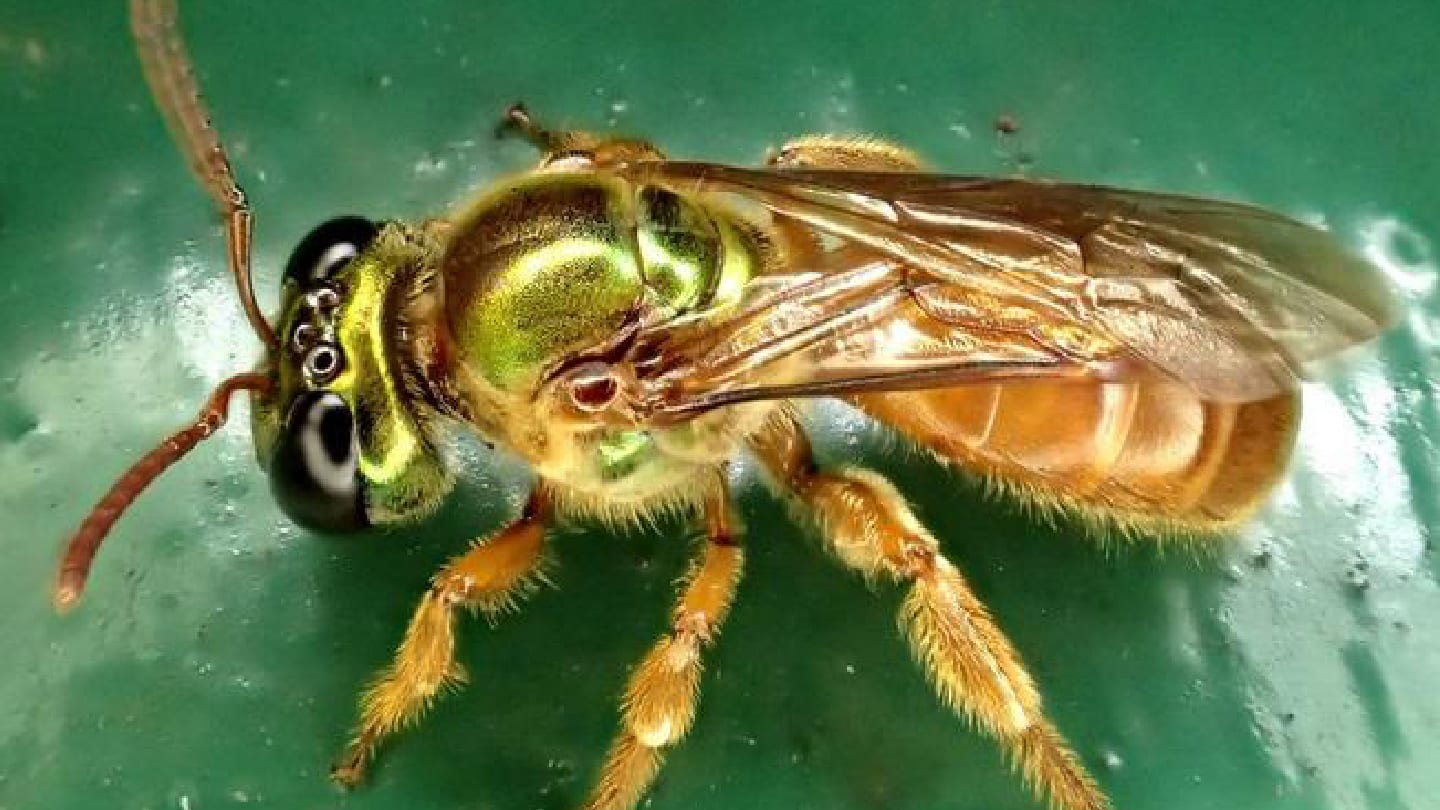
The team then repeatedly sampled the chemicals coating the bees’ bodies and analyzed their cuticular profiles using gas chromatography–mass spectrometry. The key signals were methylalkanes, a class of cuticular hydrocarbons that were elevated in social queens and rose around the time daughters emerged as potential workers.
Those pheromones appeared to work in two ways. In bioassays, methylalkanes triggered worker-like submissive behaviors; in live nests, elevated levels inhibited worker ovarian development during a critical early period. Higher methylalkane levels also predicted future queen egg-laying and the likelihood that daughters would remain in the nest as workers.
“A particularly novel aspect of this study was performing chemical analyses directly on Barro Colorado Island and repeatedly sampling live bees,” said Callum Kingwell in the Smithsonian press release, “allowing us to track chemical signaling in the same free-living individual bees throughout their lives.”
The findings suggest the queen’s chemical profile is not simply coercive control, but an honest signal of whether helping her is likely to pay off. “Chemical signals like these may stabilize nascent insect societies, buying time for social complexity to emerge over evolutionary time,” said Bill Wcislo.
Newsletters
Receive the latest analytical science news, personalities, education, and career development – weekly to your inbox.