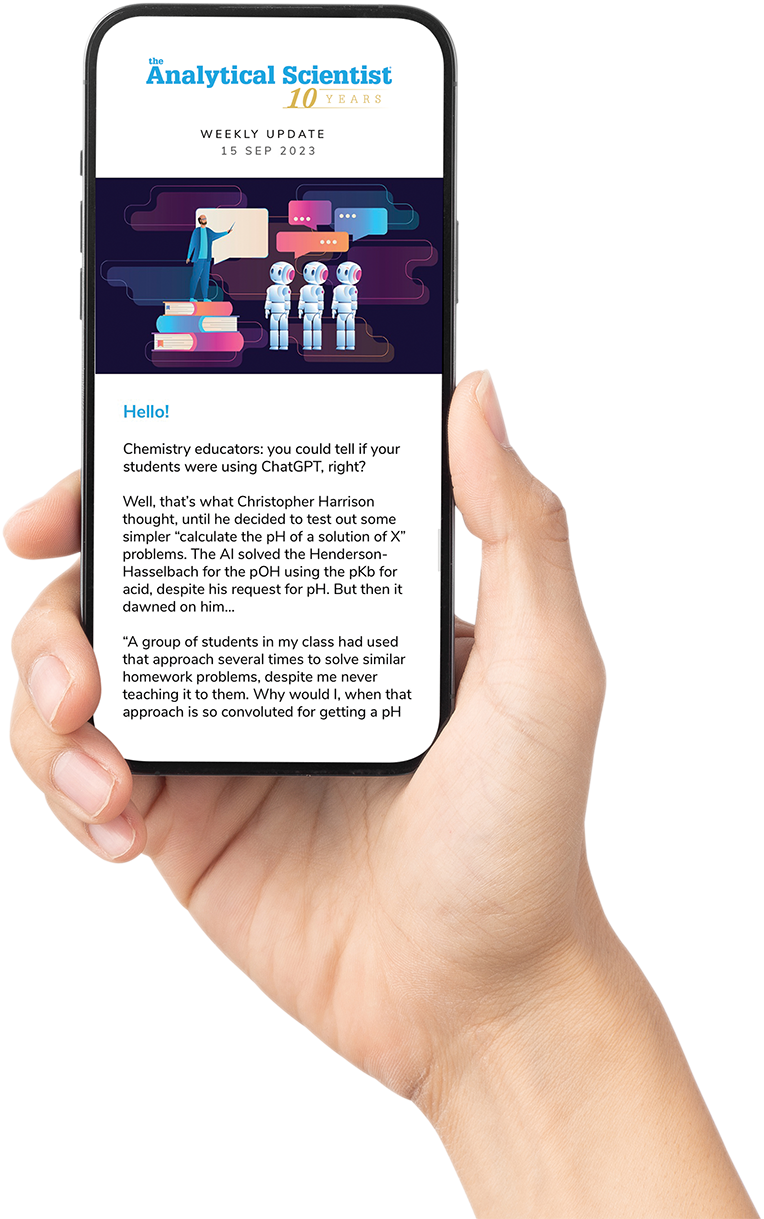
Can’t make every conference this year? You’re not alone – and we wanted to make sure you don’t miss out. Welcome to our first Coffee Break interview, where we capture the informal, thought-shaping conversations that happen between sessions.
Here, James Grinias, Professor of Chemistry and Biochemistry at Rowan University, USA, reflects on what’s trending at recent meetings – from cross-disciplinary collaboration to ongoing debates around AI.

What are the big trends you’re seeing at recent meetings?
There’s definitely a strong push toward interdisciplinary research.
There’s been a shift in how programs are organized. So you’ll see analytical chemists, biological chemists, and synthetic chemists all contributing to the same sessions, often working toward shared goals.
A lot of that work is centered around areas like pharmaceutical development, biomedical devices, and energy and fuels. Those are major themes, and they naturally bring in techniques like separations and mass spectrometry.
Is that trend being driven by analytical chemistry, or more by those application areas pulling in analytical tools?
Is that trend being driven by analytical chemistry, or more by those application areas pulling in analytical tools?
I think it’s a bit of both, but also driven by how conferences themselves are evolving. Attendance is generally lower than it was 20 or 25 years ago, so there’s a need to bring people together in broader, more integrated ways. There are also practical factors – costs are increasing, so combining audiences and sessions makes logistical sense.
From a scientific perspective, a lot of the innovation comes at those touchpoints between fields. If you’re solely focused within your own area, it’s harder to figure out what problems other people are having that we, as analytical chemists, can help solve.
That’s why people often say it’s measurement technology that drives discoveries in other fields. So the question becomes: where are those challenges, and how can we help them overcome them?
Any other topics cropping up in conference corridors?
There’s an ongoing debate around the role of AI and machine learning. How much should students rely on these tools, and how much should they still develop a deep understanding of the fundamentals? Instrumentation is also becoming more automated – more “push-button” – which changes how people interact with the underlying science.
There’s a vision where someone could simply input a problem – say, “I have these five molecules, how do I separate them?” – and get a complete answer. Some people think that’s just a few years away. I’m a bit more cautious. I think we’re still some distance from that, partly because there isn’t enough high-quality empirical data to fully support those kinds of predictions.
So there’s a wide range of opinions, and no clear answer yet. But that tension – between automation, AI, and fundamental understanding – is really at the heart of the conversation right now.
Should students learn the fundamentals given the way AI and automation are trending?
I think it’s important that students still learn the fundamentals, especially because I don’t think we’re as close to fully automated solutions as some people suggest.
Understanding the fundamentals makes a big difference when it comes to troubleshooting. If you know how a system should work at a basic level, it’s much easier to identify what’s going wrong and why. Without that, you’re more reliant on external tools.
You can, of course, ask a large language model for help, and it might give you a list of possible solutions. But I’m a bit concerned about how people are using these tools. There’s a lot of AI-generated content circulating – particularly on professional platforms – and not all of it is accurate. Some of it contains clear mistakes, even when it’s presented as a reliable guide.
Used carefully, these tools can be helpful as a starting point, as long as you verify the information. But relying on them without that critical step is risky. And if you don’t understand the fundamentals, it becomes much harder to assess whether what you’re being told is actually correct.
So for me, that’s the key issue: without a solid grounding, people are more likely to take information at face value – and that’s a concern.
I will note that I have been impressed with the ways that experts in the field have put AI to use in terms of “vibe coding” – I know that several colleagues have been able to create useful tools for chromatographers that would have taken much longer to code in the past.
Will automation kill analytical science jobs?
There are different levels of automation available, but adoption is still limited in part because of cost. Over time, those costs will likely come down, and we may see more fully integrated systems – where sample prep, analysis, and method optimization are all connected in iterative workflows.
At some point, you could imagine a lab where much of that process is automated. But for the average lab, another key question is: when does it become cheaper to run a fully automated lab than it is to have staff? The economics are a critical piece, and they will influence how quickly things change.
A lot of times with these developments, people worry that jobs are going to be lost. But especially in pharmaceuticals – not every industry, but pharma in particular – the driving impetus is to make new drugs, and that’s a long, complex process. Increased throughput doesn’t necessarily lead to significant reductions in force; what it can do is enable things to happen faster and speed up the overall process. That’s my more optimistic view.
And we’ve seen that before – for example, with UHPLC. There were concerns it would reduce the workforce, but in practice it allowed analysts to generate more data, faster. So instead of doing less with fewer people, labs often end up doing more with the same resources.
What’s exciting you most at the moment – either in your own work or more broadly across the field?
I think for me, it’s the continued push toward miniaturization in separations – particularly exploring what capillary LC can really do. There are clear sustainability benefits, but also potential advantages in simplifying workflows and improving efficiency.
I’m especially interested in the idea of making capillary LC a more routine part of day-to-day LC workflows. That’s still somewhat on the horizon, but it may be closer than we think. I’m starting to see more interest from industry as well – areas that may have been overlooked in the past are now being reconsidered.
We’ve also been working on high-throughput LC, and when you pair that with mass spectrometry, capillary LC is a much better match than traditional analytical-scale LC. The challenge is making it robust enough for broader use, but if we can do that, it could significantly expand the tools available to scientists.
Ultimately, what motivates me is the idea of developing technologies that help people solve problems faster. It’s not just about doing the same things inexpensively – it’s about enabling new capabilities and accelerating discovery.
That connects closely to both research and education: how can we create tools and approaches that allow people to move more quickly from question to answer? I think that’s a big part of where the field is heading.
For that vision of miniaturization to be realized, do you think it will require a major breakthrough – or more gradual, iterative progress?
I think it’s probably a combination of both, but largely driven by iterative improvements. On the instrumentation side, there have already been advances in miniaturizing different components and integrating them more closely together.
For broader adoption, though, it really depends on continued uptake – those two things go hand in hand. The more people adopt the technology, the more it will develop and improve.
One of the key limitations right now is actually on the column side. There are still relatively few columns available at that scale, and that’s been a bottleneck. As manufacturers see more demand and expand their offerings, that should start to ease.
When I was training, capillary LC was mostly seen as a proteomics tool, with limited applications beyond that. But over the past 15 years or so, that perception has started to shift, and I think that trend will continue.
In LC more broadly, do you think we’re likely to see a truly transformative breakthrough – or is progress more likely to remain incremental? And if something revolutionary did emerge, would that surprise you?
I think theory already tells us what the “ideal” separation would look like. In principle, it would resemble a very high-efficiency separation – almost like an extremely narrow version of what you see in GC, but with liquid flow instead of gas.
But there are significant engineering challenges, and probably some physical limitations that are difficult to overcome, even with very advanced systems. For example, when you’re working at very high pressures, heat generation becomes an issue.
That said, I think there’s still a lot of room for progress. There are opportunities to improve stationary phase design, instrument performance, and overall system efficiency. And again, moving to smaller scales – like capillary LC – helps, because lower flow rates allow you to achieve things that are harder at larger scales.
I think the key is continuing to aim for that very high bar. Even if we don’t reach the theoretical ideal, the incremental steps along the way will still advance the field.
In terms of a completely unexpected breakthrough, it’s possible – but I think most efforts are focused on moving toward what theory already tells us is achievable. And getting there will require advances across multiple areas: detection, instrumentation, and column manufacturing.
Another challenge is how that work is supported. It’s difficult for academia alone to drive these long-term developments, and industry may be hesitant if the payoff is on a decades timescale rather than something more immediate. So it really requires a balance between academic research, government support, and industry involvement.
We are seeing more academics spinning out startups to help bridge that gap, which is an interesting shift. But overall, I think progress will continue – just likely through steady advances rather than a single, dramatic breakthrough.
Finally, thinking about real-world impact – how important is it to push analytical techniques toward their theoretical limits? And how does that connect to solving broader societal challenges?
I think it depends. There are still people using technology from 20 or 30 years ago who are perfectly happy with it – it works reliably, and there’s no strong motivation to change. There’s always a balance between doing things a bit faster or at lower cost, and the investment required to adopt new technology.
But the bigger question is where analytical chemistry fits in driving discovery. If you look at areas like healthcare, for example, it’s really those super high-efficiency separations coupled with very strong mass spectrometry capabilities that are going to enable the discovery of unique biomarkers or biological targets – things that new therapeutics could target to treat diseases that today are still incurable.
The same applies in environmental science. As we try to detect smaller amounts of compounds in more complex samples, we need increasingly powerful analytical tools, including the realm of sample preparation. That’s where pushing performance really matters.
And if you think even more broadly – space exploration, for example – we’ve been sending analytical instruments like GC systems on probes for decades. If we want to learn more about the universe, we’ll need even more advanced measurement technologies.
So there are always new frontiers. For me, a big motivation is seeing these tools used by people outside analytical chemistry – clinicians, for example – who can use them to give patients answers more quickly.
At the end of the day, analytical chemistry sits at the center of the scientific process. Science is about making measurements, testing hypotheses, and refining our understanding – and we provide the tools that make that possible.
So even with the rise of AI and automation, I think analytical chemists will continue to play a key role in solving important problems.
Newsletters
Receive the latest analytical science news, personalities, education, and career development – weekly to your inbox.