Biopharmaceutical developers are under increasing pressure to shorten development timelines and move increasingly complex molecules into the clinic with lower attrition. Many labs rely on LC-MS-based workflows for charge variant analysis, intact mass confirmation, and peptide mapping. While powerful, these methods often require extensive method development, column selection, gradient optimization, desalting, and ongoing system maintenance.
As biologics pipelines expand and modalities diversify, expanding to fields such as bispecific antibodies, fusion proteins, and RNA therapeutics, analytical labs are under increasing pressure to deliver faster answers – particularly in early process development and clone screening.
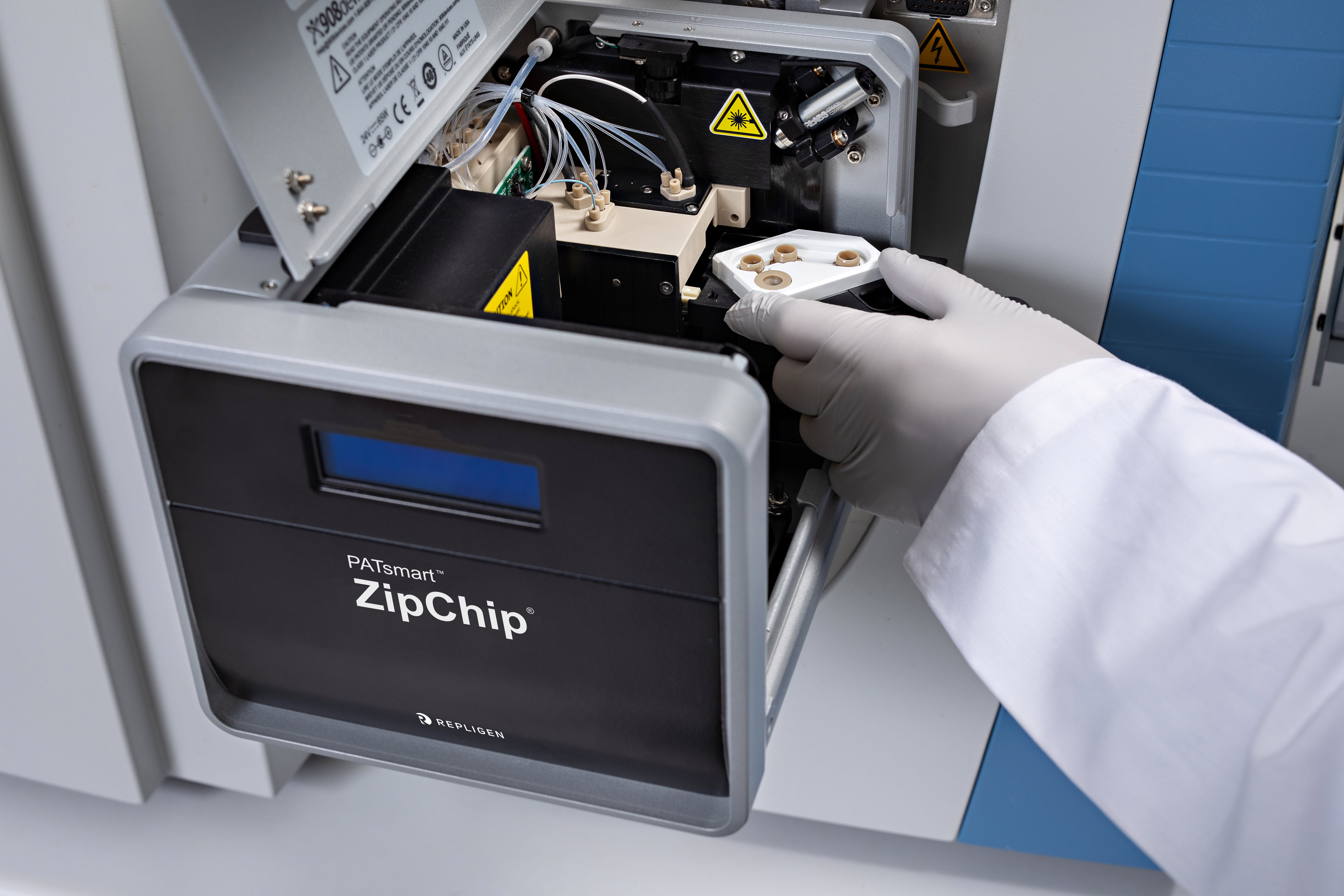
In this context, microfluidic capillary zone electrophoresis-mass spectrometry (CE-MS) interfaces have emerged as a viable alternative to LC-based characterization workflows. The PATsmart™ ZipChip® interface from Repligen couples directly to existing mass spectrometer platforms, enabling high-resolution electrophoretic separation, alongside MS detection.
We spoke with Simon Krabbe, Senior Scientist in CMC Analytical Characterization, who uses CE-MS at the Servier Antibody Center of Excellence, to find out more about the challenges facing bioanalytical labs and how Servier Symphogen is using CE-MS to simplify and accelerate MS-based biotherapeutic characterization.
What major trends are shaping the way biotherapeutics are developed and characterized today? And how are these changes influencing the demands placed on analytical laboratories responsible for biotherapeutic characterization?
We are increasingly seeing more complex biopolymer formats that need to be screened and characterized earlier in the development cycle, at higher throughput and lower concentration. This partly aims to develop robust developability prediction algorithms to improve the quality of molecules entering early development. That puts a lot of demand on the quality of data delivered by analytical laboratories, where sensitivity, accuracy, and speed need to be high, while sample manipulation needs to be kept at a minimum – preferably keeping the molecules at a native state while still being able to accurately assign impurities.
How do analytical turnaround times influence decision-making and which are the most time-consuming?
It depends on where we are in the development cycle. Earlier in the cycle, turnaround time needs to be very fast, and that means we are limited in terms of the kinds of data that can be provided, so we try to tailor analytical packages that will provide sufficient quality and speed to decide candidates to move forward.
Later in the development cycle, characterization needs to be more thorough, which requires more methods but also more time. This requires careful sample planning and prioritization of analytical methods so the fastest and most revealing methods can be used for initial decisions, while confirmatory and resource-heavy methods can be used for decision-polishing at a later timepoint. If analytical turn-around time becomes too long, some decisions would have to be taken at undesirable risk.
These days, we have more automated solutions for sample preparation and optimized acquisition methods, so the most time-consuming portion is when the platform workflows need to be adjusted and validated. But also, the data analysis part is highly time-consuming and still requires human interaction and interpretation despite many efforts being made for implementing AI tools.
Many characterization workflows today rely on LC-MS. What are some of the practical challenges associated with developing and maintaining these types of methods in busy analytical labs?
LC-MS as a platform has matured and can work very reliably; however, it is impractical to have different methods running on the same LC, so it is highly advantageous to dedicate LC’s for specific methods, which wouldn’t necessarily be economically feasible.
We have some of our systems set up with single platform methods at high demand, and then some flexible systems for method development and more infrequently used methods, which ensure maximum use of all our systems with a minimum of intervention. But it does mean that some of the more specialized methods require a bit of attendance for setting up the LC, flushing solvents, columns, and troubleshooting any failed system suitability tests (SSTs).
And when working with complex modalities, each molecule format often requires analytical optimization and an expanded set of methods for satisfactory characterization. This requires additional resources and requires an easily adaptable setup. Platform methods often fall short.
How significant is sample preparation in MS-based characterization workflows, and what kinds of challenges arise when working with complex matrices or upstream samples?
It’s of course important that the sample solution is MS-compatible and preferentially free from components that suppress analyte ionization. For highly complex matrices, you would normally have to perform a pre-analysis sample clean-up, and for some biomolecules it can be difficult to achieve the desired sample recovery. When working with mAb-based formats, we usually have the benefit of domain-targeting resins that can aid in sample clean-up, but again, may not be economically feasible in a high-throughput environment.
What advantages can CE-MS offer compared with more traditional LC-MS approaches for certain biologics analyses?
CE-MS can provide on-line sample clean-up, which can be a huge advantage and is especially well-suited for upstream sample analysis where you can omit elaborate sample clean-up before analysis. For example, when working with mAbs that often have a relatively high pI, you can limit the migration of lower pI components into the MS. CE also works at the nano-scale, providing excellent sensitivity, which is necessary for the often limited sample amounts obtained from upstream in early development. With CE-MS, you can also effortlessly obtain a charge variant profile, providing insights into molecule properties and stability.
Microfluidic CE-MS interfaces are designed to couple directly to existing high-resolution mass spectrometers. From a practical standpoint, how does this type of setup change the way analysts can approach biotherapeutic characterization and what is the overall benefit?
Being able to interface directly to our existing mass spectrometers means that we can have a highly flexible lab, ensuring that we can operate at maximum MS capacity. At the same time, the generated CE-MS data taps directly into our data cloud without IT intervention. Here, we can analyze the data in a familiar environment and use analysis workflows shared with LC-MS.
What types of applications particularly benefit from this kind of CE-MS workflow?
CE-MS is useful for developability and comparability assays, where deep characterization is needed and orthogonal methods are required.
Here, we use CE-MS primarily for charge variant analysis of mAbs and find it particularly useful for stability-indicating assays, where we need to determine the level of deamidation, which can easily be done both at the intact and subunit level.
In early development for stable pool generation and clone screening, when decisions sometimes are required at a very early stage, we have also deployed CE-MS, which provides the necessary analysis turnaround-time and the required sensitivity for the low concentration samples.
For laboratories already equipped with high-resolution MS platforms, how realistic is it to integrate CE-MS approaches into existing characterization workflows?
The practical setup can be very easy and flexible with a direct CE-MS interface, and systems like the ZipChip are very easy to operate, meaning you can quickly add CE-MS to existing characterization workflows, where the data analysis platform will be familiar. With kit-based applications, there is also limited method development required, so you will quickly begin to acquire useful data.
Any final thoughts?
CE-MS enables high resolution separation and high sensitivity detection, which meets the analysis requirements of complex biopharmaceuticals in challenging matrices. This makes it an excellent platform for early screening but also to provide orthogonal analysis for deep characterization. The flexibility and ease of operation with modern CE-MS interfaces make it an indispensable tool for mAb-format biopharmaceutical analysis in a characterization laboratory.
Interested in learning more about CE-MS for biotherapeutic characterization? Click here to connect with Repligen.
Newsletters
Receive the latest analytical science news, personalities, education, and career development – weekly to your inbox.