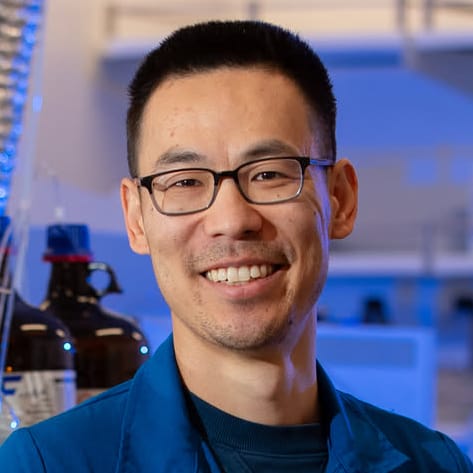
Mingxun Wang
Assistant Professor, Department of Computer Science and Engineering, University of California, Riverside, USA
False
Assistant Professor, Department of Computer Science and Engineering, University of California, Riverside, USA
Mingxun develops computational tools that help analytical scientists extract greater value from mass spectrometry data. He has played a central role in developing GNPS and now leads the development and maintenance of GNPS2, an open ecosystem for molecular networking and metabolomics. His contributions also include MASST, MassQL, MassIVE-KB, metabolite annotation, and community curation.
“As a computational lab, we are truly in the business of serving the rest of the analytical community,” he says. “Fundamentally, we want to make the mass spectrometry data that the world generates have value in understanding the chemical world around us.”
“Having a tight network of experimental collaborators enables what I do,” Mingxun says. “My group thrives on making sure our tools solve real analytical challenges.” This requires collaborators to test computational approaches “early and often in the development process,” even when the solutions are still “half-baked.” Their feedback helps his group “choose the right approaches to solve the actual analysis challenges.”
Originally trained as a computer scientist, Mingxun had little formal education in chemistry or biology. During graduate school, he read several organic chemistry textbooks and spent time working on the experimental side of the laboratory. “This really helped give me a foundation to communicate effectively with my experimental peers,” he says. “The openness to understand each other’s fields has really opened the doors for my research and collaboration.”
Receive the latest pathologist news, personalities, education, and career development – weekly to your inbox.

False