Conexiant
Login
  • The Analytical Scientist
  • The Cannabis Scientist
  • The Medicine Maker
  • The Ophthalmologist
  • The Pathologist
  • The Traditional Scientist
The Analytical Scientist
  • Explore

    Explore

    • Latest
    • News & Research
    • Trends & Challenges
    • Keynote Interviews
    • Opinion & Personal Narratives
    • Product Profiles
    • App Notes
    • The Product Book

    Featured Topics

    • Mass Spectrometry
    • Chromatography
    • Spectroscopy

    Issues

    • Latest Issue
    • Archive
  • Topics

    Techniques & Tools

    • Mass Spectrometry
    • Chromatography
    • Spectroscopy
    • Microscopy
    • Sensors
    • Data and AI

    • View All Topics

    Applications & Fields

    • Clinical
    • Environmental
    • Food, Beverage & Agriculture
    • Pharma and Biopharma
    • Omics
    • Forensics
  • People & Profiles

    People & Profiles

    • Power List
    • Voices in the Community
    • Sitting Down With
    • Authors & Contributors
  • Business & Education

    Business & Education

    • Innovation
    • Business & Entrepreneurship
    • Career Pathways
  • Events
    • Live Events
    • Webinars
  • Multimedia
    • Video
    • Content Hubs
Subscribe
Subscribe

False

The Analytical Scientist / Issues / 2026 / February / Young Blood Slows Alzheimers in Mice
Translational Science Translational Science News and Research Clinical

Young Blood Slows Alzheimer’s in Mice 

Proteomics connects exposure to blood from older donors and synaptic dysfunction in the brain 

02/10/2026 1 min read

Share

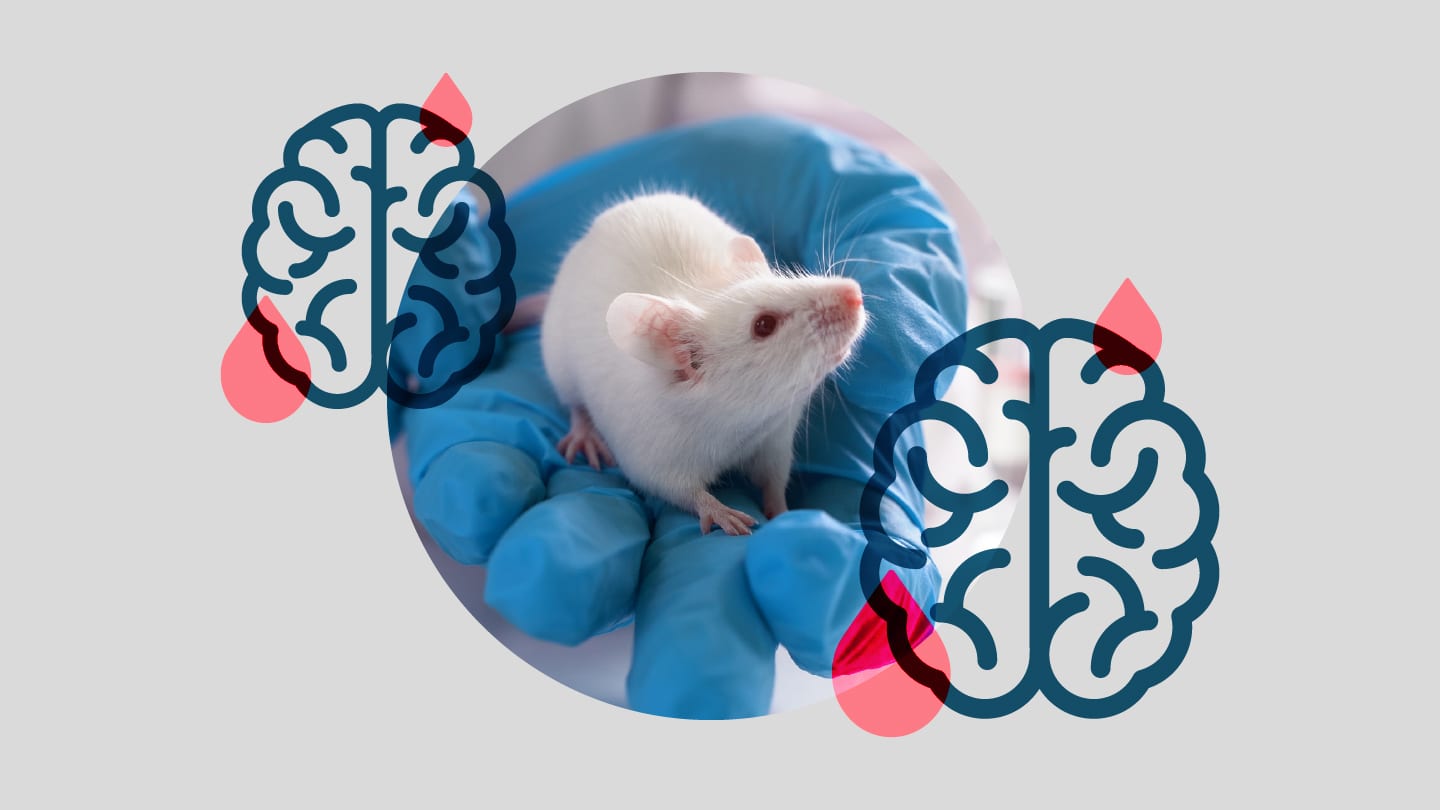
Credit: Mouse image sourced from Adobe Stock

Molecules in donated blood can influence the progression of Alzheimer’s-like pathology in the brain, according to a new mouse study. Led by scientists at the Instituto Latinoamericano de Salud Cerebral (BrainLat) at Universidad Adolfo Ibáñez, Chile, the study examined whether circulating factors outside the brain could modulate disease-associated changes. 

Using Tg2576 transgenic mice, which overexpress human amyloid precursor protein, the team administered weekly infusions of whole blood from either young or old wild-type donor mice over a 30-week period. Cognitive performance was assessed using the Barnes maze: a test of spatial memory. Mice receiving blood from older donors showed significantly impaired short- and long-term memory compared with those infused with young blood.  

Histological analysis further revealed increased amyloid-β (Aβ) deposition in the cerebral cortex of mice treated with aged blood, detected by immunohistochemistry using the 4G8 antibody. In contrast, mice receiving young blood exhibited lower amyloid burden in these regions. 

To investigate molecular changes associated with these effects, the researchers carried out a large-scale proteomic analysis of brain tissue. High-resolution mass spectrometry enabled quantification of more than 3,300 proteins, with 256 showing differential expression between treatment groups. Pathway analysis linked these changes to synaptic signaling, endocannabinoid pathways, and calcium-dependent neuronal regulation. 

One protein highlighted by the analysis was the α2δ2 subunit of voltage-gated calcium channels (CACNA2D2), which was upregulated in mice infused with aged blood and validated by western blotting. The authors suggest that altered expression of this protein may contribute to synaptic dysfunction and impaired neuronal communication. 

MELISA Institute contributed to the proteomic component of the study, using a trapped ion mobility spectrometry–time-of-flight platform to generate the dataset. “Within this study, we conducted a large-scale proteomic analysis that allowed us to generate excellent quality data in this complex matrix like plasma, a technical challenge for any proteomics laboratory,” said Mauricio Hernández, a proteomics specialist at MELISA Institute, in a press release. 

According to senior author Claudia Durán-Aniotz, the results highlight the importance of systemic influences on neurodegeneration. “By demonstrating that peripheral signals derived from aged blood can modulate central processes in the pathophysiology of Alzheimer’s, these findings open new opportunities to study therapeutic targets aimed at the blood–brain axis.”  

The authors emphasize that further work will be needed to identify the specific circulating factors responsible and to assess whether similar mechanisms operate in humans. 

Newsletters

Receive the latest analytical science news, personalities, education, and career development – weekly to your inbox.

Newsletter Signup Image

False

Advertisement

Recommended

False

Related Content

The Analytical Scientist Innovation Awards 2024: #5
Translational Science
The Analytical Scientist Innovation Awards 2024: #5

December 4, 2024

4 min read

Welcome to the 5th ranked Innovation, Pyxis – introduced here by Matterworks co-founder Jack Geremia

The Analytical Scientist Innovation Awards 2024: #4
Translational Science
The Analytical Scientist Innovation Awards 2024: #4

December 5, 2024

6 min read

Thermo Fisher Scientific’s high-sensitivity mass spec for translational omics research – the Stellar MS – is ranked 4th in our annual Innovation Awards

The Analytical Scientist Innovation Awards 2024: #3
Translational Science
The Analytical Scientist Innovation Awards 2024: #3

December 6, 2024

4 min read

Bruker’s multiphoton microscopy module, OptoVolt, ranks third in our Innovation Awards. Here, Jimmy Fong, product development lead, walks us through the major moments during development.

Spit It Out
Translational Science
Spit It Out

December 4, 2024

1 min read

Saliva-based PA-MS test detects paracetamol overdose in just 10 minutes

False

The Analytical Scientist
Subscribe

About

  • About Us
  • Work at Conexiant Europe
  • Terms and Conditions
  • Privacy Policy
  • Advertise With Us
  • Contact Us

Copyright © 2026 Texere Publishing Limited (trading as Conexiant), with registered number 08113419 whose registered office is at Booths No. 1, Booths Park, Chelford Road, Knutsford, England, WA16 8GS.