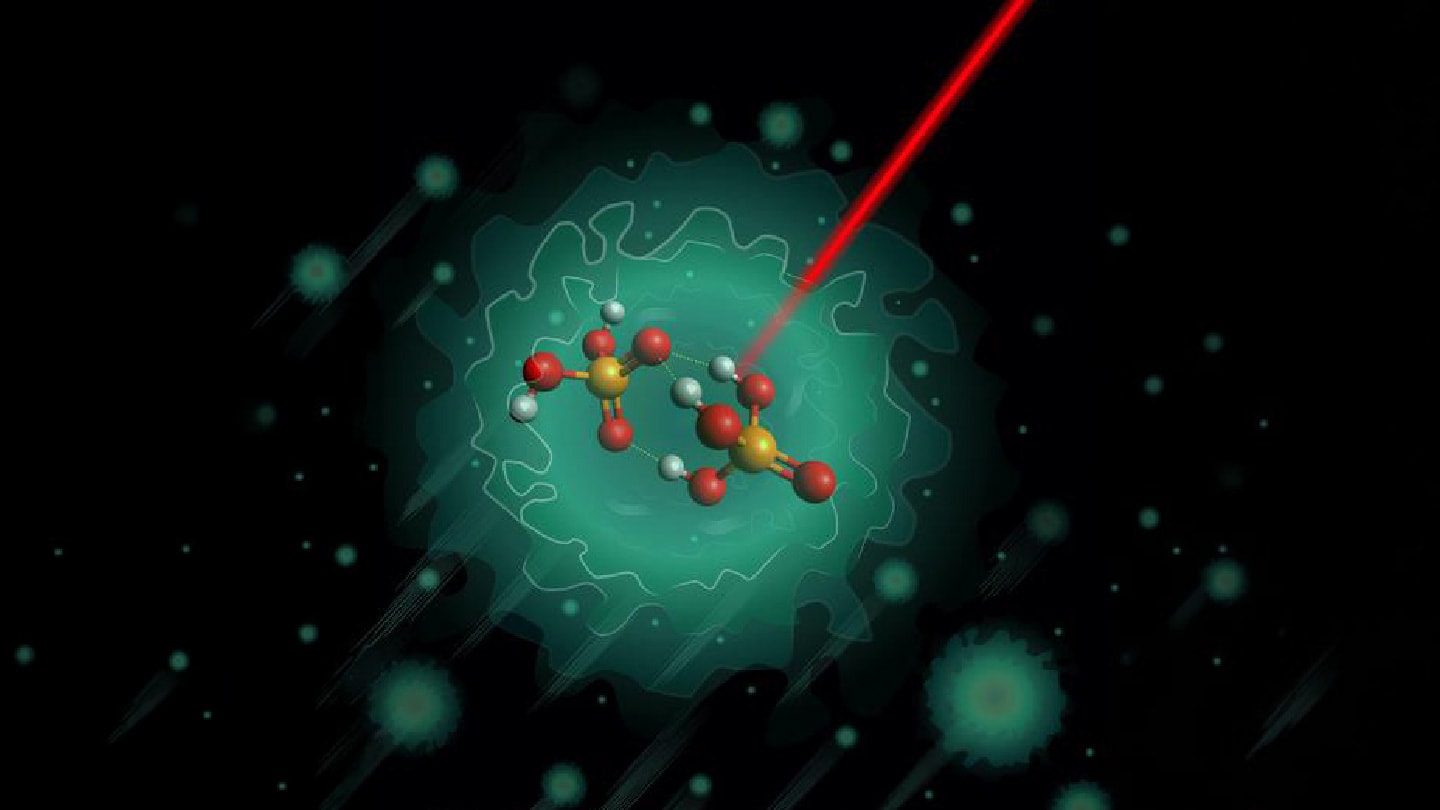
A cryogenic spectroscopy study has resolved a previously unreported structure for a phosphoric acid dimer implicated in proton transport, offering new insight into the hydrogen-bonding arrangement that may underlie phosphoric acid’s high proton conductivity.
Phosphoric acid is central to both biology and energy technology, but the molecular steps behind its unusually efficient proton transport remain incompletely understood. In the new study, researchers examined a deprotonated phosphoric acid dimer linked to that process, using helium nanodroplet infrared action spectroscopy, D₂-tagging infrared photodissociation spectroscopy, and quantum chemical modeling to determine its structure.
Although calculations placed two dimer structures at nearly the same energy, the experimental spectra provided a clear assignment to a single structure. Across both cryogenic methods, the data consistently supported a single structure, termed A1 by the authors, while the alternative arrangement showed much poorer agreement with the observed vibrational bands. That favored structure contains three hydrogen bonds spanning five oxygen atoms, including an unusual motif in which two hydroxyl groups coordinate to the same oxygen atom.
The assignment was also reinforced by the agreement between the two cryogenic spectroscopic methods. Given the different experimental environments associated with helium nanodroplet and D₂-tagging measurements, the close spectral correspondence suggested that neither approach introduced a substantial structural perturbation.
The structural assignment rested on several spectral signatures. In the fingerprint region, helium nanodroplet spectra of both the protonated and deuterated dimers matched the calculated A1 spectrum more closely than the competing model. In the O–H and O–D stretching regions, infrared photodissociation and helium droplet spectra again favored A1, particularly when anharmonic effects were included in the calculations.
The results underscore the limits of relying on theory alone when phosphate clusters adopt structures with very similar predicted energies. They also support a specific hydrogen-bonding arrangement that may be common in phosphoric acid systems and could help explain how those systems sustain efficient proton transfer.
According to the authors, that structure could help benchmark future quantum chemical models and guide studies of larger deprotonated phosphoric acid clusters.
Newsletters
Receive the latest analytical science news, personalities, education, and career development – weekly to your inbox.