Conexiant
Login
  • The Analytical Scientist
  • The Cannabis Scientist
  • The Medicine Maker
  • The Ophthalmologist
  • The Pathologist
  • The Traditional Scientist
The Analytical Scientist
  • Explore

    Explore

    • Latest
    • News & Research
    • Trends & Challenges
    • Keynote Interviews
    • Opinion & Personal Narratives
    • Product Profiles
    • App Notes
    • The Product Book

    Featured Topics

    • Mass Spectrometry
    • Chromatography
    • Spectroscopy

    Issues

    • Latest Issue
    • Archive
  • Topics

    Techniques & Tools

    • Mass Spectrometry
    • Chromatography
    • Spectroscopy
    • Microscopy
    • Sensors
    • Data and AI

    • View All Topics

    Applications & Fields

    • Clinical
    • Environmental
    • Food, Beverage & Agriculture
    • Pharma and Biopharma
    • Omics
    • Forensics
  • People & Profiles

    People & Profiles

    • Power List
    • Voices in the Community
    • Sitting Down With
    • Authors & Contributors
  • Business & Education

    Business & Education

    • Innovation
    • Business & Entrepreneurship
    • Career Pathways
  • Events
    • Live Events
    • Webinars
  • Multimedia
    • Video
    • Content Hubs
Subscribe
Subscribe

False

The Analytical Scientist / App Notes / 2013 / SEC Analysis of mAbs Using TSKgel SuperSW mAb Columns

SEC Analysis of mAbs Using TSKgel SuperSW mAb Columns

05/02/2013

Share

Featured Image
Introduction

Antibody therapeutics are enjoying high growth rates in the biopharmaceutical market, the major areas of therapeutic application being cancer and immune/inflammation-related disorders including arthritis and multiple sclerosis. In 2010, four of the top ten best-selling global drug brands were monoclonal antibodies (mAbs). The characterization of these complex biomolecules is a major challenge in process monitoring and quality control. The main product characteristics to be monitored are aggregate and fragment content, glycosylation pattern and charged isoforms. The standard method used in biopharmaceutical QC for mAb aggregate and fragment analysis is size exclusion chromatography (SEC). A new series of silica based HPLC columns can be applied to either increase speed or improve resolution of the separation of antibody fragments, monomers and dimers.

Experimental

IgG was digested with papain over 24 hours. The fragmentation process was monitored by analyzing 10 or 5 μl aliquots of the sample. Mobile phase: 200 mmol/L phosphate buffer + 0.05% N aN3, pH 6.7 Flow rate: A & B: 1.0 ml/min C: 0.35 mL/min Injection vol.: A & B: 10 μl; C: 5 μL Temperature: 25°C Detection: UV @280 nm Samples: 10 g/L IgG digested with papain for 0-24 hr Columns: A : TSKgel G3000SWXL, 7.8 mm ID x 30 cm B : TSKgel SuperSW mAb HR, 7.8 mm ID x 30 cm C : TSKgel SuperSW mAb HTP, 4.6 mm ID x 15 cm

Separation of mAb Fragments, Moomers and Dimers
Figure 1A
Figure 1B
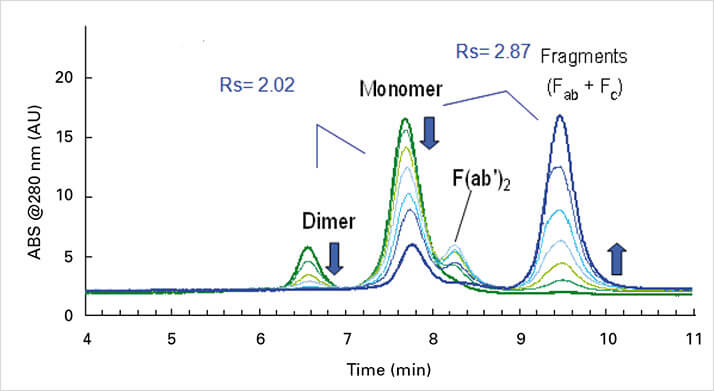
Figure 1C - Separation of antibody fragments, monomers and dimers by SEC A: TSKgel G3000SWXL, 7.8 mm ID x 30 cm; B: TSKgel SuperSW mAb HR, 7.8 mm ID x 30 cm C: TSKgel SuperSW mAb HTP, 4.6 mm ID x 15 cm
Results

Figure 1A shows the separation of a papain digested immunoglobulin G sample on a TSKgel G3000SWXL column, which is applied as the standard SEC column in routine analysis of aggregates in many QC and R&D labs. Figure 1B demonstrates that the resolution of the separation can be improved by using the new TSKgel SuperSW mAb HR (HR stands for ‘High Resolution’) with 4 micron silica particles. This column provides higher resolution than the conventional column at the same analysis time. Using the TSKgel SuperSW mAb HTP (HTP stands for ‘High Throughput’), a short semi-micro column packed with the same 4 micron particles as SuperSW mAb HR, dimer/ monomer/ and fragments were separated at the same resolving power as on the conventional column but in half the analysis time (Figure 1C). 

Summary

Size exclusion chromatography (SEC) is a common method for the separation of antibody monomer from dimer, aggregates, or degradation products on the basis of molecular size. Two novel SEC columns designed for antibody separation exhibit reduced analysis time while achieving baseline separation or enhanced resolution between monomer and dimer.

Download the PDF of this App Note here.

Newsletters

Receive the latest pathologist news, personalities, education, and career development – weekly to your inbox.


Newsletter Signup Image

Explore More in Pathology

Dive deeper into the world of pathology. Explore the latest articles, case studies, expert insights, and groundbreaking research.

False

Advertisement

Recommended

False

Related Content

Extraction of Multiple Mycotoxins From Grain Using ISOLUTE<sup>®</sup> Myco prior to LC-MS/MS Analysis

April 25, 2013

This application note describes a Solid Phase Extraction (SPE) protocol for the extraction of a range of mycotoxins from wheat flour, wheat, maize and barley using ISOLUTE® Myco with LC-MS/MS...

Analysis of 18 Polycyclic Aromatic Hydrocarbons in Soil Using the QuEChERS Method

April 29, 2013

The use of QuEChERS dispersive SPE as a simple, fast, and quantitative sample preparation method is demonstrated for the GC-MS analysis of 18 polycyclic aromatic hydrocarbons (PAHs) in soil...

Analysis of Low Level Pyrethroid Pesticides in Water

April 29, 2013

A method for the determination of pyrethroids in water at ultra-low-level concentrations of 0...

Determination of Phthalates in Drinking Water by UHPLC with UV Detection

April 29, 2013

To develop an efficient high-performance liquid chromatography (HPLC) method for the simultaneous determination of 19 phthalate compounds in drinking water...

Thank you for reading The Analytical Scientist

To continue reading, either register for a free account below or login.

Register or Login

False

The Analytical Scientist
Subscribe

About

  • About Us
  • Work at Conexiant Europe
  • Terms and Conditions
  • Privacy Policy
  • Advertise With Us
  • Contact Us

Copyright © 2026 Texere Publishing Limited (trading as Conexiant), with registered number 08113419 whose registered office is at Booths No. 1, Booths Park, Chelford Road, Knutsford, England, WA16 8GS.